
Designed by Leonard Lin
Kinda makes you want to go, doesn’t it?
Designed by Leonard Lin
Kinda makes you want to go, doesn’t it?
Implement is 9/10s of the law.
Don’t forget it.

 I got an invite from the good folks at WebBreakStuff today to check out Goplan, their latest product beta (but it’s apparently not a beta).
If you’re not on the invite list, you can go check out their Flickr set or mine (very cool to offer that, by the way).
The base feature set includes Notes, Blog, Calendar, Tickets, Tasks, Files and Campfire-like Chat rooms. When creating new Projects, you can select which of these features that you want to include.
I have to say that I love the feel of this app… if they can offer single sign-on with something like OpenID and Microformats, I think I’ll be in love. Or infatuated at least. For a little while.
There are a few quirks (like the Add Event form and date validation) but the biggest problem so far seems to be adding other users… unless it’s a project space of one, this might be the loneliest collaboration software I’ve ever seen! 😉
So bottom line — Basecamp still has the edge, but with competition like this (no word on the pricing model yet), I’m eager to see how these loose pieces coming together can help empower the independents really building the future of the web.
. . .
While I’m at it, I should shout out to Fred and co. for organizing a very successful BarCamp in Portugal. Perhaps the most inspiring result of this event relates directly to Goplan:
The event was a success and made us consider working closer to the portuguese IT market – something we’ve been kinda skeptical about mainly because it always seemed like it wasn’t ready for the kind of services we offer. Check out the event photos over at Flickr.
If BarCamp can bring a tighter focus on local communities outside the valley, that’s a true accomplishment, and a goal that we set for the event from the very beginning.
It’s been a while since I’ve seen such a large and complete collection of free, vector-based icons… I just had to share!
Just wanted to point out that folks should keep their eyes on SoundFlavor, a little project I worked on awhile back. Not sure when it’s going to launch, but it’s definitely got legs.
Hey hey, anyone else notice that LinkedIn is sporting some fancy new Web 2.0 gradients and open white space? Just in time for OpenBC’s OpenDesign contest conclusion!
Too bad they didn’t get on the microformats tip. Kinda seems like a waste of effort without them, don’t it?

Cris Pearson of Plasq (makers of Comic Life) showed me a bundle of screensavers he was working on a few weeks ago and are now available free for downloading.
This excellent set includes:
 The Multipack are throwing a Zen Garden-esque contest called PimpMyHTML. They really should have called it PimpMyMicroformats given that they’re using the follow microformats:
The rules are pretty straight forward, and as I’m a fan of constraints and AJAX+CSS+XHTML, I’m looking forward to the entries:
And as you’re limited in filesize, it might be worth your while to go check out the forthcoming Mootools and read up on some ideas on exploiting CSS instead of using JavaScript. And while you’re at it, Molly has two articles on microformats definitely worth a gander.

When I was at Flock, one of the things that I advocated for most vehemently was to take more inspiration from game design — to look to influences in Halo, World of Warcraft, the The Sims and others to come up with novel approaches to socially browsing the web.
Well, Aaron Ruby, writing for NextGen, captures exactly what I wanted to add to the open source design process:
And that’s what game designers do: they create objects that invite play.
The Microsoft Office model of interface design no longer applies; rows of buttons simply aren’t fun and because they’re not fun they actually reduce focus and productivity.
Though there will continue to be a need for transitional browsers, I’m looking to games like Spore to set the stage for next generation interaction models and work/time flows.

Photo © copyright Fabio Prati.
My PiC has yet another great post on identifying who you should be “targeting” when you’re building a startup, product, community or all three.
The Pinko approach demands that you become a member of your community to truly understand their needs and the world from their perspective. In fact, this is the only way for you to really be able to genuinely respond to their feedback and criticism, otherwise you’re always approximating what presume they’re saying…
When I was at Spread Firefox and planning out our adoption strategy, I followed very similar principles (though I didn’t have a catchy framework like “Pinko” at the time). By seeing the existing community as made up of concentric circles of enthusiastics and early adopters, my goal was to create a black hole suction of sorts deeper into the inner core community:
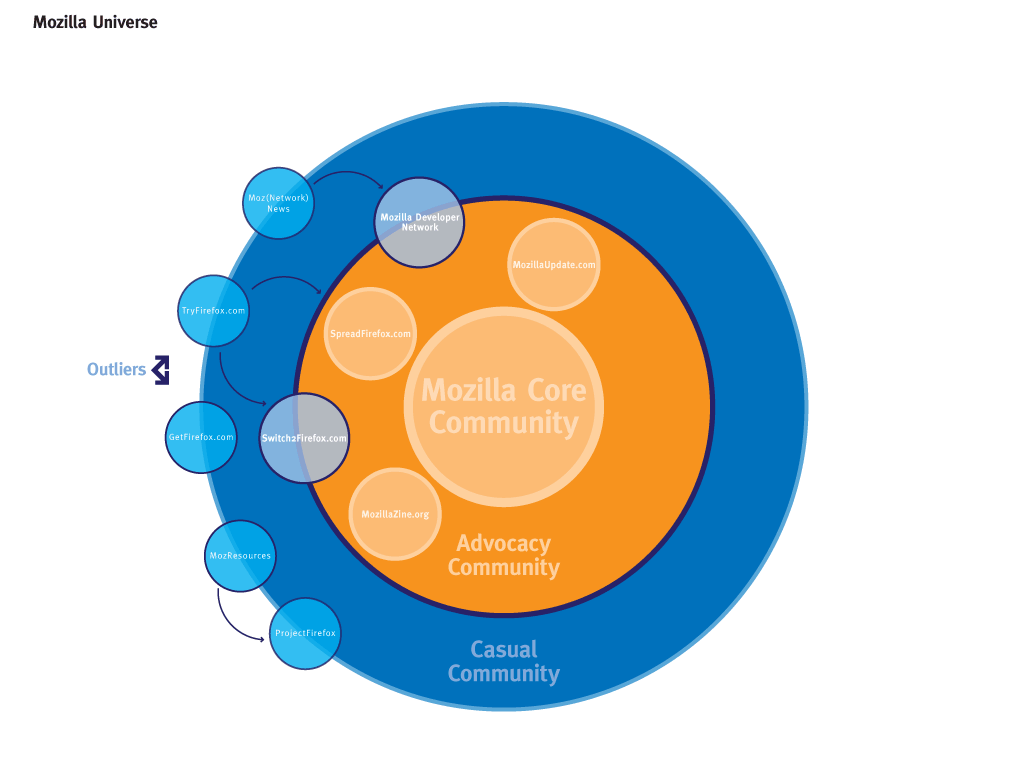
My theory was that the more folks we could bring into the inner rings of the Mozilla community, the more devoted they’d become and the lower the incremental effort we’d need to exert to pull in more outliers, like their friends, coworkers and family members.
Tara’s argument very much mirrors this approach. By focusing your effort and outreach on a core constituency, just like in a presidential campaign (read: Howard Dean), you’ll be enticing folks with a truly valuable service that those same folks can then turn around and preach about with more convincing passion, integrity and self-interest than you could… the very reason that the Spread Firefox campaign was so successful; it relied on concentric circles of true-believers to spread the word. For its part it only had to focus on continuing to build a great product and delivery community infrastructure to support its core constituency.
So when it comes to community barn-raising and product development, keeping your design and development efforts geared to a tightly knit core of enthusiasts is the best way to create the first drop that will ripple out to the wider audiences that your VCs are constantly (and damagingly) telling you to go after. There’s simply no better way to effectively and organically build out to a wider audience than taking the concentric circles approach.
 Factory Joe