Web 2.0 Trademark Closure

So in case you missed it, Tim O’Reilly has posted a follow-up about the Web2.0 Trademark spat that engulfed the blogerati a few months back. I put in my own two cents pertaining to the relevance of the debate to my Community Mark initiative.

The outcome seems that Tim has asked CMP to take a more narrow view of their trademark: It will only seek to protect the Web 2.0 trademark if another other Web 2.0-related event has a name that is confusingly similar to the names of the actual events co-produced by CMP and O’Reilly, such as our events “The Web 2.0 Conference” and “The Web 2.0 Expo.”

So while I can appreciate Tom’s initial Irish-blooded reaction (309 comments!?!), I think this is a fair compromise in the end. I can also see why people confused “O’Reilly” with “CMP”; Tim, take this with a grain of salt, but I think more than anything, this is a common misconception that is wholly yours to clear up, which, with this post, I think you have done.

Now that that’s behind us, maybe we should start talking about what’s next for digital rights online?

A lesson from game design

Spore preview
When I was at Flock, one of the things that I advocated for most vehemently was to take more inspiration from game design — to look to influences in , World of Warcraft, the The Sims and others to come up with novel approaches to socially browsing the web.

Well, Aaron Ruby, writing for NextGen, captures exactly what I wanted to add to the open source design process:

And that’s what game designers do: they create objects that invite play.

The Microsoft Office model of interface design no longer applies; rows of buttons simply aren’t fun and because they’re not fun they actually reduce focus and productivity.

Though there will continue to be a need for transitional browsers, I’m looking to games like Spore to set the stage for next generation interaction models and work/time flows.

Designing for concentric circles of adoption

Water drops by Fabio Prati
Photo © copyright Fabio Prati.

My PiC has yet another great post on identifying who you should be “targeting” when you’re building a startup, product, community or all three.

The Pinko approach demands that you become a member of your community to truly understand their needs and the world from their perspective. In fact, this is the only way for you to really be able to genuinely respond to their feedback and criticism, otherwise you’re always approximating what presume they’re saying…

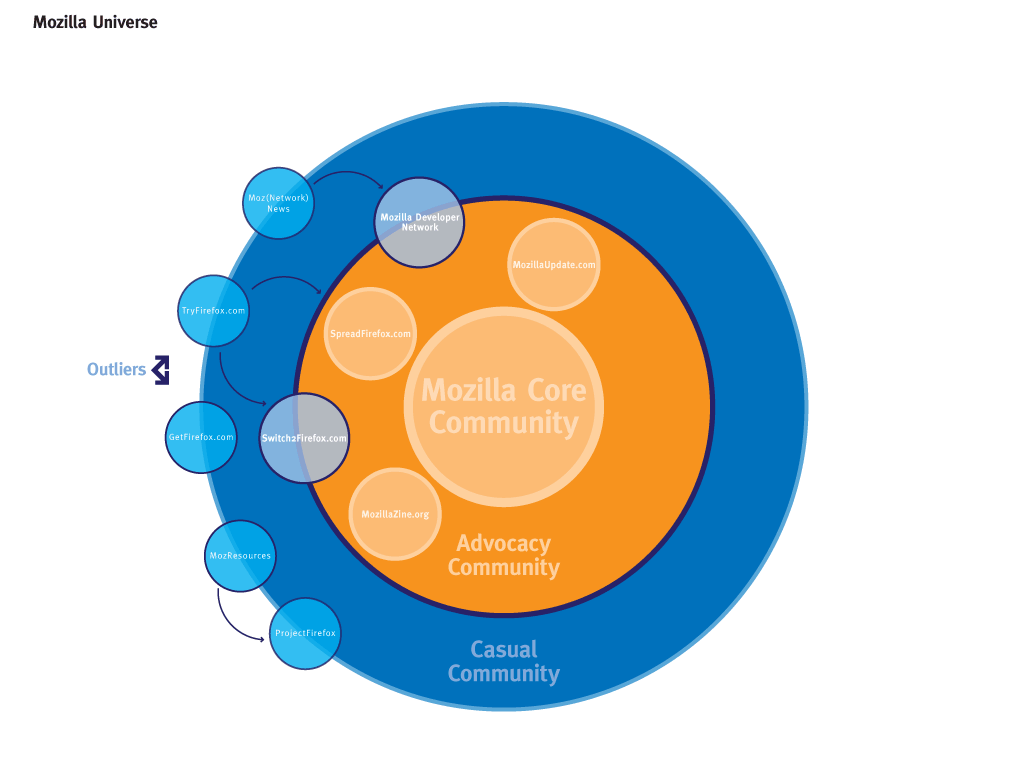
When I was at and planning out our adoption strategy, I followed very similar principles (though I didn’t have a catchy framework like “Pinko” at the time). By seeing the existing community as made up of concentric circles of enthusiastics and early adopters, my goal was to create a black hole suction of sorts deeper into the inner core community:
Mozilla Universe v1

My theory was that the more folks we could bring into the inner rings of the Mozilla community, the more devoted they’d become and the lower the incremental effort we’d need to exert to pull in more outliers, like their friends, coworkers and family members.

Tara’s argument very much mirrors this approach. By focusing your effort and outreach on a core constituency, just like in a presidential campaign (read: ), you’ll be enticing folks with a truly valuable service that those same folks can then turn around and preach about with more convincing passion, integrity and self-interest than you could… the very reason that the Spread Firefox campaign was so successful; it relied on concentric circles of true-believers to spread the word. For its part it only had to focus on continuing to build a great product and delivery community infrastructure to support its core constituency.

So when it comes to community barn-raising and product development, keeping your design and development efforts geared to a tightly knit core of enthusiasts is the best way to create the first drop that will ripple out to the wider audiences that your VCs are constantly (and damagingly) telling you to go after. There’s simply no better way to effectively and organically build out to a wider audience than taking the concentric circles approach.

Fighting spam: Call in Akismet!

Call in Akismet!
Original photo courtesy of Rich Legg. Used with permission.

It’s painful to watch the many approximate pattern-based spam-fighting attempts that come up from time to time that we all know will eventually be made obsolete. Ultimately such tricks will only end up leading to more time spent weeding out false positives while the spammers stay ahead of the curve (it is their business, after all).

So not long ago, I started dumping an external catch-all account into Gmail. Since I use a new email address with every account and new beta that I sign up for (in order to catch offenders who leak my data — GoDaddy being the worst as domain registration records are public unless you pay), I started getting blasted with spam sent to randomly generated addresses.

Initially Gmail did an incredible job catching the spam; since I’ve been using this technique for the past two months, Gmail has easily caught over 250,000 spam messages.

Now, that’s not to say it’s perfect. In fact, especially lately, far from it. Though Gmail is in the unique position to harvest email from across its entire user-base and adapt its algorithm instantly the moment one of its accounts gets hit, it still can’t hit everything 100%. So, even as this is one of the biggest advantages of using a hosted email service like Gmail, it still lets more spam through than I’d like.

As far as I know, Google does not exchange spam data with other email providers (though maybe it does, I’m not sure). Whatever the case, I’m always interested in diverse tactics to dealing with spam. And given the success I’ve found with spam-squashing plugin on my blog, I wonder if this technology couldn’t be adapted for email?

In particular, I think that early adopters suffer from a different kind of spam abuse than most. That’s only a hunch, but I think that we make ourselves more vulnerable, especially in case of using catch-all accounts (a cardinal sin of spam management, from what I hear).

Perhaps the application of Akismet to the early-adopter spam problem could act as an additional networked preventative measure, leveraging spam trends across all email platforms, just as Akismet is starting to do for blogging platforms.

I dunno, I’m not an expert in this domain, but Akismet is one of the most promising instances of spam fighting and prevention that I’ve found and I’d love to have the same piece of mind in my email that it affords me on my blog. Could we give an Akismet-bot POP3 access to Gmail and let it loose? Better yet, could we run Akismet client-side as a Greasemonkey or Firefox extension? Again, the details probably aren’t as important as the results.

So, Matt, what’d it take to sik Akismet on my email?

On open letter to Blogger

bloggerformatsWith Blogger in the throes of a new beta cycle, it seems the ideal moment to get support into one of the more popular blogging platforms on the web.

With that goal in mind, I sent an open request letter to the Blogger-Help discussion group. No responses yet, but if you’re interested in seeing this happen, please follow up in whatever way you think might be most effective… tanks!

Hello,

Not sure to whom I should address this request, but I’m very excited about the Blogger Beta and that it represents an open opportunity to add support for microformatted content.

You can read more about microformats at microformats.org, but to summarize, microformats are community-developed standards for identifying certain kinds of information in webpages using your typical HTML tags and classes.

In particular, this is my wishlist of microformats that I would love to see Blogger support:

  • : okay, you already took care of this one, so kudos!
  • XFN: WordPress already supports this, and it’s especially useful for representing lists of friends in blogrolls.
  • rel-me: from the XFN family, being able to link to other pages on the web using rel=”me” creates an informal means of “claiming” other places where I publish online. Read about Ma.gnolia’s addition of rel-me.
  • : marking up personal profiles in hcard means that if I add personal contact details, people can click a link to add me to their address book without any extra typing. I’ve done this on my main blog. Clicking the “Add me to your address book” link will convert the HTML content in that page into a .vcf file that most address book programs can recognize.
  • : In order to make it easy for my readers to add events that I’ve blogged about to their calendars (Google Calendar or others, like iCal), I can use hcalendar to mark up this information with a link to add the events to their calendar. Here’s an example.
  • hAtom: This one is fairly simple to implement since you’re already classing most of this information already. hAtom uses element names from Atom as class names. This allows people to subscribe to blogs directly, without the need to subscribe to RSS. You can read more about this.

Though the benefits may not seem immediately obvious to supporting microformats, the amount of effort required to add support is fairly minimal compared with other, more substantial features that you’re probably already working on. Furthermore, our community would be happy to help with the process of adding support to Blogger, validating your work and providing guidance along the way. This initiative is also not a commercial effort; rather, it represents the work of a large, distributed, worldwide community that wants to build out the value of the “lowercase semantic web” and to make data storage in web pages a reality.

In some respects, we are at a chicken-and-egg crossroads but the more support that we see for microformats in the wild, the more tool makers, publishers, browsers and other applications will reap the benefits of this effort to essentially modernize the web, incrementally building upon the existing infrastructure.

Thanks for your consideration and please let me know if there is any way that I can be of service.

Chris

SilverOrange looking for a designer

SilverOrange dude SilverOrange, the fine folks behind the Digg design and Mozilla dot org are looking for a new designer.

Personally I’d jump at the opportunity, but as you probably know, I have a source of prior employment.

What might be interesting to note is that my entire foray into Silicon Valley life came to fruition because of a post I read on Steven Garrity’s blog in August 2004 about Mozilla looking for volunteer designers. I replied, got pulled into their backend intranet doing design volunteer work, a few weeks later we pushed out Spread Firefox and the rest, as they say, is history.

So I’m just saying, this could be the opportunity that sets you off in whatever direction the fates have picked out for you.

P.S. And no, this doesn’t mean I’m starting a job board (heh). I’m just doin’ a favor for some friends.

The Power of a Question

Last night, during Suw‘s Vodka Gathering, Tara raised a question, primarily to Tantek, that went a little something like this:

Which is more valuable: money or human life?

She changed the phrasing on her blog to:

What means more to you? Money or human life?

Delving further into the topic this morning, and reflecting on the responses Tantek and I gave that were primarily mathematical, theoretical and of the “it depends…” nature, I offered yet another rephrasing to capture the emotional quotient she was really asking about:

Which do you feel more strongly about: money or human life?

What’s interesting to me is how much different my response is to the “more than” question as opposed to the “feel strongly about” version. Is this a male/female thing? Is it that, regardless of how’s the questioned formed, the masculine view (not only taken by men, mind you) will be to immediately work out the logic of the matter rather than, in the feminine approach, to tease out one’s emotional reaction? Is there a neuter form of the question (i.e. in the Latin sense) that would be more uniformly comprehended between the sexes?

What do you think?

Google Image Labeler relies on crowdshop labor

Google Image Labeler

Folks are buzzing about Google’s new time wasting playable Image Labeler. Philipp Lenssen says:

More than a game, for Google this is a way to tag images using human brain power… to improve their image search results. Two people finding the same tag can serve as validation the tag makes sense. I suppose for Google it’s not important that two people find the same keywords at the same time – they can simply let people tag the images and then add any threshold they want (like “4 people must have chosen this tag for it to become a confirmed tag”).

Both Search Engine Watch and TechCrunch made the connection to research conducted by Luis von Ahn at my alma matter that was first blogged about as early as December last year (written up in the Pittsbrugh Post Gazette in August 2005).

According to Danny Sullivan at Search Engine Watch, the Google technology is indeed based on von Ahn’s work:

Yes, Image Labeler is based on my ESP Game, which Google licensed. I’m not employed by Google, however, since I’m a full-time faculty member at Carnegie Mellon.

In my experience, I found the images were often too small to make out clearly, whereas in similar systems like Amazon’s Mechanical Turk, you get much higher resolution photos.

Interestingly, uses a similar but closed system of human tagging to populate its object search. It’s unclear how such a system scales for web wide results unless something like Google or Amazon’s tool find enough widespread pick-up and open up an API to the tagged images.

CrossOver Beta brings PC apps to the Dock

IE6 on the Mac

My open source buddy-slash-analyst Raven Zachary (who also brought me news of the Green Phone) pinged me to tell me that CodeWeavers have launched the beta of , a full WINE environment port to OSX that lets you run Windows apps without… Windows! (…unlike Parallels which is a virtual machine.)

I wrote about this idea in July and it appears that the reality of OSX subsuming Windows is coming ever-closer.

Though many of the folks whoa are most excited about this are gamers, Raven’s screenshot proves how valuable and convenient this will be for Mac web developers who have been locked out of native Internet Explorer testing.

Oh, and pre-ordering saves you $20, gets you 3 months of extra service and a free upgrade to CrossOver Mac 6.0 (just an FYI).

Open source OCR in the wild

About as sexy as an eye exam, but damn, this technology is difficult to get right. So yesterday Google announced the open sourcing of Tesseract OCR, character/text-recognition software it developed back in the 80’s that it claims is better than most of the open source alternatives (I’d believe that) but not quite as good as some of the commercially available technologies (I’d buy that too).

But hmm, isn’t there a lot that could be done with this? Personally, can’t wait until we see this make it’s way into OpenOffice among other places.