Patents: the tar pits of modernity

Labrea Tar pits
Photo © copyright Adam Loeffler.
I don’t understand why someone hasn’t patented the patent process and shut down the whole racket. There’s nothing that inspires more fear, has created more anger and resentment and held back innovation in the POMO world (thanks Dave!) more than the US Intellectual Property system — and most notoriously copyright and patents.

Now, I’m not an intellectual property communist — far from it. In fact, I’m very much about people getting credit for their work, for their inventions, their ideas and in due time, compensation — both economic and social.

But the system is effed. And as there are alternatives to copyright and trademark, there similarly needs to be an open source alternative to patents, that allows the creative and ingenious to receive credit and kudos without creating a chilling effect on future and subsequent derivative innovation — innovation that has historically been built on borrowed and hacked ideas. Innovation necessary for human progress to continue at the pace it’s at today.

It’s bad enough that sentient creatures will look back centuries — if not decades — from now and laugh at how us humans smogged ourselves to death. Oh no, they’ll also barrel over in hysterics at how we held back our creatives by denying them the freedom to dabble freely and openly without the both fear of being blatantly ripped off as well as slapped with a law suit for violating someone else’s property rights. “What a bunch of cheap trust they had back then”, they’ll quip. “it’s a wonder that the little guys continued to play along even after the whole balance had shifted away from protecting them to protecting the overbloated incumbents!”

I mean, how else can you explain this quote from Christopher Lunt, formerly Friendster’s senior director of engineering (recently made refamous for their social networking patent)?

“My approach was defensive,” he said. “We were not looking to stifle creativity by competitors, nor to make money by licensing. We were making sure that things material to our business were protected, so someone else couldn’t claim the idea.”

“I dislike the current patent process,” Lunt added. “I feel it’s a little too permissive in terms of what is granted as a patent. But that doesn’t mean I can ignore it.”

Gah!! What a waste! Of money! Of talent! Of time! To have to register defensive patents is bullshit. The answer, quite simply, is something more proactive… more positive… duh! It’s open patent licensing! And why our legal system hasn’t codified this yet, well, that’s because you don’t make money off of open systems — you make money because of openness. And that’s something that our legal system, at least the purveyors of the modern legal system, could give a rat’s patootie about. It’s far too subtle. Kind of like that boiling frog in Al’s movie… or the dinosaurs paying no heed as the weather was getting colder… before the Ice Age. Or as the black ground started rising above their shins… drowning in the refuse of their own ancestor’s remains.

Web 2.0 Trademark Closure

So in case you missed it, Tim O’Reilly has posted a follow-up about the Web2.0 Trademark spat that engulfed the blogerati a few months back. I put in my own two cents pertaining to the relevance of the debate to my Community Mark initiative.

The outcome seems that Tim has asked CMP to take a more narrow view of their trademark: It will only seek to protect the Web 2.0 trademark if another other Web 2.0-related event has a name that is confusingly similar to the names of the actual events co-produced by CMP and O’Reilly, such as our events “The Web 2.0 Conference” and “The Web 2.0 Expo.”

So while I can appreciate Tom’s initial Irish-blooded reaction (309 comments!?!), I think this is a fair compromise in the end. I can also see why people confused “O’Reilly” with “CMP”; Tim, take this with a grain of salt, but I think more than anything, this is a common misconception that is wholly yours to clear up, which, with this post, I think you have done.

Now that that’s behind us, maybe we should start talking about what’s next for digital rights online?

Designing for concentric circles of adoption

Water drops by Fabio Prati
Photo © copyright Fabio Prati.

My PiC has yet another great post on identifying who you should be “targeting” when you’re building a startup, product, community or all three.

The Pinko approach demands that you become a member of your community to truly understand their needs and the world from their perspective. In fact, this is the only way for you to really be able to genuinely respond to their feedback and criticism, otherwise you’re always approximating what presume they’re saying…

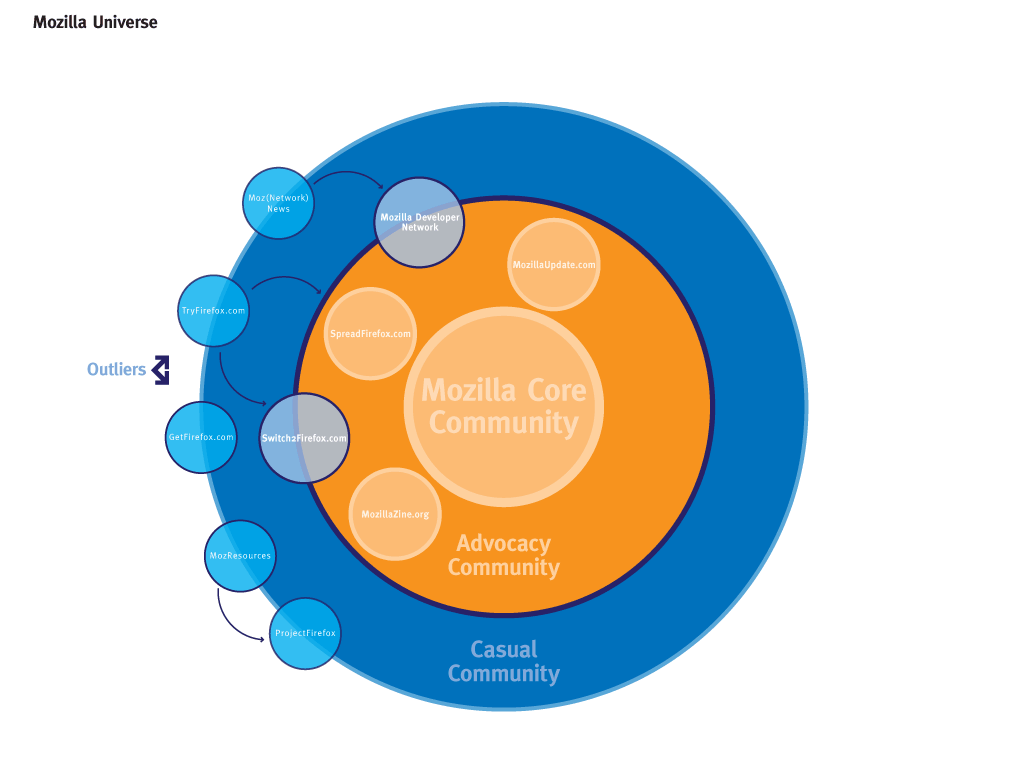
When I was at and planning out our adoption strategy, I followed very similar principles (though I didn’t have a catchy framework like “Pinko” at the time). By seeing the existing community as made up of concentric circles of enthusiastics and early adopters, my goal was to create a black hole suction of sorts deeper into the inner core community:
Mozilla Universe v1

My theory was that the more folks we could bring into the inner rings of the Mozilla community, the more devoted they’d become and the lower the incremental effort we’d need to exert to pull in more outliers, like their friends, coworkers and family members.

Tara’s argument very much mirrors this approach. By focusing your effort and outreach on a core constituency, just like in a presidential campaign (read: ), you’ll be enticing folks with a truly valuable service that those same folks can then turn around and preach about with more convincing passion, integrity and self-interest than you could… the very reason that the Spread Firefox campaign was so successful; it relied on concentric circles of true-believers to spread the word. For its part it only had to focus on continuing to build a great product and delivery community infrastructure to support its core constituency.

So when it comes to community barn-raising and product development, keeping your design and development efforts geared to a tightly knit core of enthusiasts is the best way to create the first drop that will ripple out to the wider audiences that your VCs are constantly (and damagingly) telling you to go after. There’s simply no better way to effectively and organically build out to a wider audience than taking the concentric circles approach.

Google Image Labeler relies on crowdshop labor

Google Image Labeler

Folks are buzzing about Google’s new time wasting playable Image Labeler. Philipp Lenssen says:

More than a game, for Google this is a way to tag images using human brain power… to improve their image search results. Two people finding the same tag can serve as validation the tag makes sense. I suppose for Google it’s not important that two people find the same keywords at the same time – they can simply let people tag the images and then add any threshold they want (like “4 people must have chosen this tag for it to become a confirmed tag”).

Both Search Engine Watch and TechCrunch made the connection to research conducted by Luis von Ahn at my alma matter that was first blogged about as early as December last year (written up in the Pittsbrugh Post Gazette in August 2005).

According to Danny Sullivan at Search Engine Watch, the Google technology is indeed based on von Ahn’s work:

Yes, Image Labeler is based on my ESP Game, which Google licensed. I’m not employed by Google, however, since I’m a full-time faculty member at Carnegie Mellon.

In my experience, I found the images were often too small to make out clearly, whereas in similar systems like Amazon’s Mechanical Turk, you get much higher resolution photos.

Interestingly, uses a similar but closed system of human tagging to populate its object search. It’s unclear how such a system scales for web wide results unless something like Google or Amazon’s tool find enough widespread pick-up and open up an API to the tagged images.

Ruminating on GPPLE

gppgleIt’s fun to speculate (i.e. Will gBrowser 2.0 be built on WebKit?) on what the cozying up between Apple and Google means. Is it really about search box revenue? Or is it a more insidious and calculated move, intended to push other folks to “show their cards” (so-to-speak) as to which major player(s) (or team) you want to side with?

Om’s media guess is as good as any, but I’m more interested in what this means for both search-as-platform and the future of browsers.

As we know, it’s long been speculated that Google is developing its own browser, yet the primary manifestations of this seem to be Mozilla Corp’s physical proximity to Google “All Your Base” HQ and the loving partnership on the Google Toolbar and the I’ll-pay-you-a-dollar-to-stop-searching-with-the-search-box campaign (because it’s costing us more than us giving every Firefox user a dollar!).

Could it be Mozilla’s resistance to pledge allegiance to Teh GOOG that’s causing them to look for another browser partner similarly predicated on open source roots (and thereby easily swayed with the right amount of “bought” — ahem! — I mean employed developers)?

Could it be that Apple’s iTunes Evil DRMpire is too attractive for Google to ignore and that, in wanting to gussy up before an all out Microsoft MediaCenter assault, is stacking its actors accordingly, aiming to not only deliver all the world’s information to you in a single click, but all its DRM’d content as well? Are ya feelin’ lucky?

Well do ya? Punk?

I do see some potentially significant ramifications for the browser space as more and more it’s become a search space, with very little to do with software whatsoever. While the relationship between Google and Mozilla is likely to remain strong, there may be chinks in the armor still, with Google and Apple being more 2.0 strict companies and Microsoft and Mozilla trending towards the heavier 1.5 transitional model.

Think of it this way: Mozilla and Microsoft do not have the same kind of content leverage that Google and Apple have. In fact, Mozilla has no content to sell and Microsoft, well, they’re situated squarely atop and albatross OS that promises to be a media panacea… that requires hardware most of the world doesn’t have. In the other court, Google content is already available cross platform and Apple music files have been downloaded a bazillion times into their proprietary iPod players. Would it not make sense for Google and Apple to control the entire distribution mechanism, soup-to-nuts, across all platforms? Isn’t that what Boot Camp is all about? Is that what open sourcing Darwin is all about?

Well, in all seriousness, I have no idea. But as I said, it sure is fun to conjecture! Y’know, this whole arrangement probably is just a good-natured relationship where two companies who value user experience and simplicity and are pioneers in their fields are getting together to form a union of trust and mutual support. It’s all about the users, y’know? — and doin’ what’s right for them. (If only I had a John Edwards drawl!)

Building a better mouse trap

Mousetrap

I’m struggling to make sense of something here. In Blogger’s announcement about its new beta was an interesting tidbit that didn’t get much pickup: Blogger now has a Google Data API.

There’s a lot that I could say about this, and my initial reaction was actually wrong. It seemed to me that Google was going off and inventing its own blog-publishing protocol, pulling the same crap that it did with its non-standard Event Publisher API (using random values that don’t map directly to the international icalendar standard.

But, no, it turns out that GData is actually just Atom “plus some extensions for handling queries”, but branded as a proprietary Google format (kind of ironic, given the long and pained open development of Atom).

So whatever, Atom is what comes next after RSS and MetaWeblog (in particular as ).

The important thing that started to dawn on me was this part of the announcement:

So just as Yahoo had done with Flickr (inspiring a fairly wide backlash), Blogger is going to be fully absorbed into the Google Auth-borg. This continued amalgamation of services behind the Google Account Authentication has consequences beyond the momentary outcry over Google’s supposed steamrolling of companies.

Business is business and competition is a threat to any member of an ecosystem, which is why you’ve got to keep innovating, adapting and bettering to survive. But it’s different when it comes to setting protocols and standards and the seamless moving of data in and out of disparate systems. When those protocols are closed or locked up or can be sealed off at any time, the competitive environment becomes very different.

The problem that I see is Google’s ability to shut out third party services once you’ve imported yourself into the proverbial gLife. No doubt there are feeds and the aforementioned GData APIs but it’s not an open system; Google decides which ports it wants to open and for whom. Think you’ll ever be able to cross-post calendar items from to your Google Calendar? Only if Narendra strikes a deal on your behalf — even though it’s your data. Think you’ll ever be able to share your Picasa Albums with your Flickr account? Don’t bet on it. Or — or — how about sharing your Google search history with your Yahoo account? Or merging your buddy list between Orkut and Flickr? Not a chance.

In simplest terms, with the state we’re in with centralized authentication in web applications, it’s like waiting for Microsoft and Apple to strike a deal enabling you to copy and paste from Appleworks to Word. And on top of that, you’d need to have to had created an account in both apps to even boot them up. So from a “normal person perspective”, this is a situation that you’d never want to have to worry about.

But that’s essentially where we’re at.

To put it in greater perspective: Web2.0 should have been the “great wide opening” — that is, where you could be in utter control of your data and move it in and out of services at your whim, just as you can with your money, in and out of banks depending on the quality and diversity of services they offer. And indeed, they’ve got to compete just to keep your business — if you leave, you won’t be stuck with a bunch of expiring pre-loaded debit cards.

But there’s a new trend, seen in Google’s spreading account authentication that foretells of the inevitable Passport-like lock-in that sunk Microsoft the first go ’round. You see, Google’s Account Authentication API makes it easy for you to add more and more of Google services by simply using your Gmail credentials. For Google, this leads to huge network effects, because they can essentially merge behavior data from across its entire network of services to build out a better picture of you — leading to a kind of competitive advantage that no one else can touch.

The problem though, both for you and for independent developers, is that you can’t pick and choose who or what Google works with. They’ll make themselves just open enough to be above reproach but not quite open enough to allow third parties to compete with them on their home turf (man, it’d be nice if there were a “Reply by Skype” link in Gmail — oops, Gtalk only!).

And this is how Google will build a better user mousetrap by leveraging its superior cross-product integration that its authentication system affords them.

(Aside: 37Signals partially benefits from the same kind of integration in typing Writeboards into Backpack but could go further by sharing accounts between different Basecamps).

Calling FUD on Godin

The media we use to represent ourselves has a tendency to consume us.

Or so it would, should we allow it.

Seth Godin says that The prevalance of online video, constant skype connections and the multiple threads of data we get online, combined with the enormous overhead that flying now brings might just change the [value of showing up, of being there in person, of establishing a face to face relationship with the person on the other side] for a long time to come.

Just because we’ve got all these wires and nodes and cables to keep us remotely connected offering up pixelated approximations of the real thing doesn’t mean that that basic desire to meet and to be seen and congregate shall whither. Or that the impossibility of airtravel will keep us from seeing one another in the flesh as often as we like.

Fuck that. Leila‘s right: the time has come to tap innovations, creativity and apply these to air travel and security.

…Even if that means avoiding commercial air travel altogether.

Indeed, the pilgrimages we make in the future may be fewer and further between, but that will be because we’ve built up the local ties and connections to feed our desire to connect to other — with our BarCamps, our Coworking spaces, our Citizen Spaces, across our self-run Munified networks… we will build the alternative infrastructure to support the kind of old fashioned social networking and serendipitous person-to-person reality that we’ve always craved.

The airline industry is one of the last vestiges or a foregone error that’s fought innovation at every turn to its folly. The worse it becomes for passengers, the more it exacerbates the need for something better, something more communal, something more open and distributed. Ironically, it’s easy for me to say on a blog, but I don’t think that the answer is bowing down to the threat of terror — which continually proves itself too slippery to contain… instead we need to reduce the threat and reinvest in our roots and in where we are. BarCampEarth is a celebration of our global community — proudly proving that these loosely-connected tightly-woven local communities represent more than the sum of their parts… and that our ultimate strength is found in the connections we share, no matter whoever, whenever, or wherever we are.

Fight Terrorism — Drive an Electric Avrocar

Fight Terrorism -- Drive an Avrocar

Given the terror thing on a plane over in the UK and the banning of computer and liquid carry-ons, it’s clear that the next step is flying nekkid, as Greg “Fotonotes” Elin has said.

Seems to me when you have a system like this w/ many points of big possible failure instead of one, you gotta make those points smaller and less impactful. Like individuals driving cars and/or crashing them.

Time for personal electric flying machines if you ask me (since the whole car-thing didn’t work out so well).

The mother of all mashups

Civ IV powered by Google

Yeah, the fate of all good technology is either to turn into a dating site or a videogame (sometimes both) and it’s only a matter of time before people start using Google Earth and Google Maps as the backdrop for videogames. It’s only logical, given the plight of sim games like .

But can you imagine — what if were powered by Google Earth? And in real time, the things going on in the world affected your gameplay. I mean, wow.

Surely it’s only a matter of time before such games are ported from military simulations into real games.

. . .

In other news, incoming flights are on red alert and, oh yeah, the Army has a blog. A real gem:

I love science fiction and when science actually catches up to fiction, I’m always excited about it. This could be a great defensive weapon and, of course, offensive. Could you imagine if this [system to use mirrors to shoot laser beams] was working at the start of the Iraq war? We could have sat back a little, let Osama or one of the other most wanted poke their head out and then hit them with a laser and very likely have no collateral damage. Of course the most exciting use is to knock down incoming missiles.

Of course. But the thought that we could be fighting Bin Laden and co. like it were a game of “bop the terrorist” sure is funny! LOL.

(smacks head)

Apple’s Research & Rip-off department

Peter and Apple's Copymachine

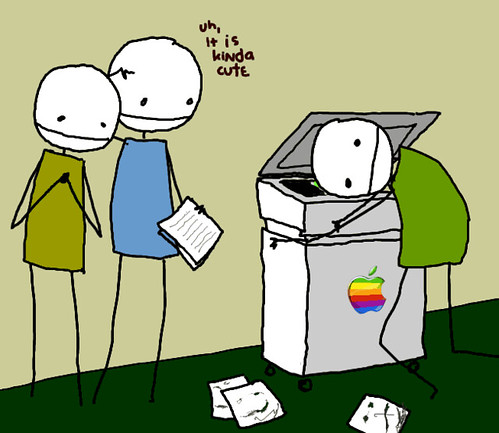
This whole thing is pretty interesting, especially when you’re as big as Apple and you have as dedicated a following as it does. And when your caché is innovation and constant coolification, you’ve always gotta deliver something wicked to knock ’em dead.

But, one supposes, those ideas need not come from within, and, when you’re Apple (or Google or whomever), looking to your community for ideas is probably as sure a bet as any for coming up with something you’d not thunk up (or at least not yet ripped off).

And so while Jobs gave his keynote at WWDC yesterday pointing out Redmond’s failure to deliver on Vista while OSX continues to steam ahead, I found it interesting that many of the features that they’re selling this upgrade with can already be found in the Mac developer community.

Take for example:

Now, don’t get me wrong. Building these features into the OS means that lots more people will get the benefit of these tools that many of us early adopters have already discovered. And, given Apple’s engineering and design pedigree, oftentimes that means that the Apple versions will be more stable, in some cases more useful and almost certainly more pretty (though not always).

But, it also means that a bunch of independent software developers who rely on selling these small but potent tools that Apple has now co-opted will lose business, not to mention get no return on the hard work, money and time spent building these tools. All Apple has to do is summarily drop a few of these features into a major dot-release, crank up the hype machine, and poof, more developers out of work. As Marc put it, what kind of ecosystem is that?

Unlike the open source community, where developer’s names are attached to the patches and contributions that they make to a project, Apple offers no such credit, and, in turn, takes all the glory.

And, if you read me much, you know that I’m a big proponent of open source, of open standards, and open formats; I also tend to see patents and trademarks as belonging to the litigious and anti-cooperative capitalist elite who can afford such protections, forcing the small business innovator to choose between either doing what she loves or taking the steps to protect it — as the cost, time and passion pursuing either makes both rather mutually exclusive.

And so it is yet another manifestation of the digital divide — of those who have the money and the legal departments to protect their innovations — or sue or pay off those who innovate for them — against those who live from registration to registration, making an independent and meaningful, yet staccatic economic, existence.

Update:Menuet developer Phill Ryu comes to pretty much the same conclusion, but with a few different examples.