Looks like the Crunchempire is spreading out, entering the crowded gadget arena. Meanwhile, GigaOmniMedia gets a facelift and a tabsplosion.
Category: Technology
The mother of all mashups

Yeah, the fate of all good technology is either to turn into a dating site or a videogame (sometimes both) and it’s only a matter of time before people start using Google Earth and Google Maps as the backdrop for videogames. It’s only logical, given the plight of sim games like SimEarth.
But can you imagine — what if Civilization IV were powered by Google Earth? And in real time, the things going on in the world affected your gameplay. I mean, wow.
Surely it’s only a matter of time before such games are ported from military simulations into real games.
. . .
In other news, incoming flights are on red alert and, oh yeah, the Army has a blog. A real gem:
I love science fiction and when science actually catches up to fiction, I’m always excited about it. This could be a great defensive weapon and, of course, offensive. Could you imagine if this [system to use mirrors to shoot laser beams] was working at the start of the Iraq war? We could have sat back a little, let Osama or one of the other most wanted poke their head out and then hit them with a laser and very likely have no collateral damage. Of course the most exciting use is to knock down incoming missiles.
Of course. But the thought that we could be fighting Bin Laden and co. like it were a game of “bop the terrorist” sure is funny! LOL.
(smacks head)
Safari on Windows

With nary a peep from the XUL Runner folks on the recent proliferation of WebKit apps, I was going to say, “Man, Firefox is so effed” but I shouldn’t say that without backing it up. And being more specific and saying “Man, Gecko is so effed” isn’t all that helpful either. And anyway, I wouldn’t be entirely correct, since really what I mean is that “the collective Gecko and Firefox community seems to be taking a long time shipping a widgetizeable and stand-alone platform for running web applications as desktop applications compared with the WebKit community”.
But anyway, in the meantime, WebKit (whose party I attended last night) is steaming right along. Especially now that you can run Safari on the PC things are going to get very interesting in the rendering engine space very quickly.
Can we get a Linux port already?
Apple’s Research & Rip-off department
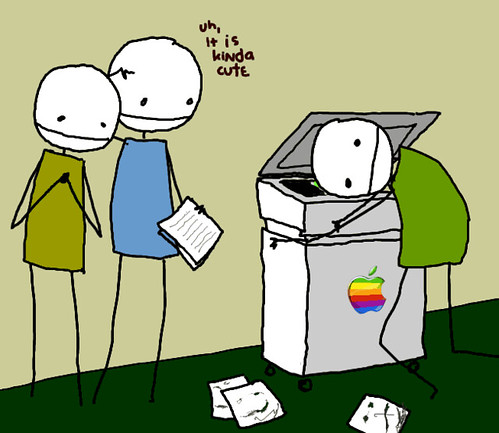
This whole crowd-sourcing thing is pretty interesting, especially when you’re as big as Apple and you have as dedicated a following as it does. And when your caché is innovation and constant coolification, you’ve always gotta deliver something wicked to knock ’em dead.
But, one supposes, those ideas need not come from within, and, when you’re Apple (or Google or whomever), looking to your community for ideas is probably as sure a bet as any for coming up with something you’d not thunk up (or at least not yet ripped off).
And so while Jobs gave his keynote at WWDC yesterday pointing out Redmond’s failure to deliver on Vista while OSX continues to steam ahead, I found it interesting that many of the features that they’re selling this upgrade with can already be found in the Mac developer community.
Take for example:
- Dashboard & Dashcode: Amnesty Singles ($9.95) and WCode ($15) and Wishingline’s Dashboard Widget Xcode Template
- Spaces: Virtue Desktops (open source), Desktop Manager (open source), You Control: Desktops ($29.95)
- Time Machine: SuperDuper! ($27.95), Lifeboat ($30), iBackup (donation-ware) or Carbon Copy Cloner (donation-ware)
- CoreAnimation: Coverflow (free), SVG or Flash (ok, not really an accurate comparison)
- Mail: (…almost too many to list) Mail2iCalToDo (free), Mail2iCal (free), Note To Self, Mail to ToDo X (free), MailTemplate ($14.95),
- iChat: Tiffany Screens (free), XMeeting videoconferencing (open source), Adium (open source)
- Spotlight: HoudahSpot ($14.95) and Meta — complex queries; Searchlight — Spotlight for networks ($29.90); Quicksilver (free), Launchbar ($19.95 – $29.95) and Butler (donation-ware) — for application launching
- iCal: Gcal (open source) + Google Calendar (free)
Now, don’t get me wrong. Building these features into the OS means that lots more people will get the benefit of these tools that many of us early adopters have already discovered. And, given Apple’s engineering and design pedigree, oftentimes that means that the Apple versions will be more stable, in some cases more useful and almost certainly more pretty (though not always).
But, it also means that a bunch of independent software developers who rely on selling these small but potent tools that Apple has now co-opted will lose business, not to mention get no return on the hard work, money and time spent building these tools. All Apple has to do is summarily drop a few of these features into a major dot-release, crank up the hype machine, and poof, more developers out of work. As Marc put it, what kind of ecosystem is that?
Unlike the open source community, where developer’s names are attached to the patches and contributions that they make to a project, Apple offers no such credit, and, in turn, takes all the glory.
And, if you read me much, you know that I’m a big proponent of open source, of open standards, and open formats; I also tend to see patents and trademarks as belonging to the litigious and anti-cooperative capitalist elite who can afford such protections, forcing the small business innovator to choose between either doing what she loves or taking the steps to protect it — as the cost, time and passion pursuing either makes both rather mutually exclusive.
And so it is yet another manifestation of the digital divide — of those who have the money and the legal departments to protect their innovations — or sue or pay off those who innovate for them — against those who live from registration to registration, making an independent and meaningful, yet staccatic economic, existence.
Update:Menuet developer Phill Ryu comes to pretty much the same conclusion, but with a few different examples.
—
I bet you could recast the whole Greeks vs Romans civilization clash as something very nearly resembling today’s Windows vs Mac relationship. There seems to be the Trojan horse (when Gates invested in Apple) and now, with OSX essentially cannibalizing Windows applications, we’re seeing the story come full circle (I certainly don’t see the visually superior Mac apps running on the PC anytime soon). Fascinating to see history repeating itself yet again.
WordPress makes a move towards hAtom, gets upgrades

I missed WordCamp this weekend (owing to the fact that I was presenting at Wikimania) but there seems to have been some good announcements that came out of the event.
For one thing, the hosted WordPress service added a few features, one of which is a $15 premier service that lets you edit your CSS. Blogger offers this service for free, but heck, WordPress is still independent and needs to have a way to bring in some dough — and as this is a highly desirable feature, will probably lead to income for the Automattic folks at least a fraction of what Cyworld is pulling in with all their custom digital paraphernalia and trinkets.
So but that’s not all… no, Andy Skelton announced (from what I hear) the availability of a new skeleton theme called Sandbox that is designed for themers. If you’re on WordPress.com you can go enable it now, as I have (it’s totally basic, so I imagine that you’ll see a lot of styles start to appear for it) or download it to put on your own blog.
I’ll actually be doing this once I return to San Francisco.
Why?
Simple: Sandbox is the first known theme to support hAtom.
Why does this matter?
The same reason why hResume matters. And then some. It’s because it not only puts more of the power of publishing into the author’s hands, but it also removes the need to RSS or ATOM.
Let me say that again: because the Sandbox theme is marked up with hAtom in its HTML, there’s no need to supply an alternative link to RSS or ATOM because the page itself is able to be read by newsreaders.
Or, will be. In the meantime, we can use Chris Casciano‘s script for NetNewWire to allow client-side subscribing or server-side transforms to convert any page into a subscribable document.
The potential here is immense — if Matt’s able to move the entirety of the WordPress.com theme base over to hAtom, we’d have quite the playground for an HTML-based syndication format, removing the overhead of generating RSS or ATOM feeds. Instead, you’d subscribe to a website and its content, not some anti-DRY format.
Update: Bill Humphries has released a version of Kubrick that supports hAtom.
Hex color grabbers
Cris Pearson just pinged me about the aptly named Hex Color Picker. This one might actually replace my former color picker of choice, iPick. You might also consider exColor, a super-simple and small tool to quickly grab hex colors with the magnifying glass.
New release of Monolingual
There’s a new release of Monolingual out that fixes the bug I submitted where removing certain architectures would kill apps that checksum their executables to prevent tampering. Monolingual now blacklists such applications a Speed Download and FontExplorer X.
—
…don’t look now, but sooner or later you’ll be able to run Windows applications right from within your Intel Mac’s OS. At one point, this wasn’t exactly obvious. Fortunately, the independent market can respond faster than the stalwarts. Whether they’ll be cannibalized later on remains to be seen.
Email isn’t dead

With cultureware services like Flavorpill launching a new email newsletter called Activate (“World News Once a Week” — subscribe) and Amit Gupta and co‘s PhotoJojo pulling in over 10K subscribers (4K via RSS) and getting Wall Street Journal ink, email newsletters are far from dead.
Just put that one away in your quiver next time some tries to suggest that email’s dead (I’ll have more on this later).
 Factory Joe
