PimpMyHTML

PimpMyHTMLThe Multipack are throwing a Zen Garden-esque contest called . They really should have called it PimpMyMicroformats given that they’re using the follow :

The rules are pretty straight forward, and as I’m a fan of constraints and AJAX+CSS+XHTML, I’m looking forward to the entries:

  • You can’t change the HTML at all.
  • Use Best Practices of both CSS and JavaScript.
  • Limited to a maximum of 20kb of JavaScript.
  • No more than 5 image files can be used. (If you use your noggin, this isn’t much of a problem.)

And as you’re limited in filesize, it might be worth your while to go check out the forthcoming Mootools and read up on some ideas on exploiting CSS instead of using JavaScript. And while you’re at it, Molly has two articles on microformats definitely worth a gander.

OmniWeb 5.5 out, based on WebKit

OmniWeb 5.5

Moving off of outmoded WebCore, has come out with , based on WebKit. In my tests, it still has some bugginess loading certain websites, but on the whole, it’s a solid browser that I find using as my trusty secondary (after Camino, of course).

This release is important because it adds yet another to the growing stable of WebKit browsers in the wild.

It also sets a number or precedents with regards to visual tabs, customizing your surfing experience web-wide or at the individual site level and adds RSS subscriptions to its standard feature set. It’s still not the perfect browser, but it’s certainly a contender (though with a $30 price tag, I’m not sure anyone but Omni fans will be willing to ante up with so many decent competitors out there).

Hyperscope and the future of the past

The mother of all demos
Photo by John Lester.

I can’t quite tell how significant this is, but I know that it’s been a long time coming and that, only over time, will we begin to understand what this system will really mean for information systems.

In classic understated flair, Doug, Eugene and Brad will be releasing the Web 2.0 version of Doug Engelbart’s Hyperscope to the world tonight.

It’s hard for to describe succinctly, but basically it’s taking hypertext and adding the “hyper” to it (today’s web linking is kind of like the Model-T compared to Engelbart’s space age original 1968 vision). You’ve really got to try it for yourself to see what I mean; what at first seems like a big outline (it’s cleverly built on top of OPML) quickly becomes an immersive experience that other system pale in depth and flexibility to.

In some respects, this kind of learnable system is what I was talking about in my post on learning from game design. The only presumption, or goal, of the Hyperscope system is that you’re interested in working with knowledge and information — how you go about finding, linking to, appending or operating on that information is up to you.

All that and it’s built on Alex Russell’s Dojo Toolkit is an achievement in open source cross pollination that should be also be duly recognized.

Congrats guys.

A lesson from game design

Spore preview
When I was at Flock, one of the things that I advocated for most vehemently was to take more inspiration from game design — to look to influences in , World of Warcraft, the The Sims and others to come up with novel approaches to socially browsing the web.

Well, Aaron Ruby, writing for NextGen, captures exactly what I wanted to add to the open source design process:

And that’s what game designers do: they create objects that invite play.

The Microsoft Office model of interface design no longer applies; rows of buttons simply aren’t fun and because they’re not fun they actually reduce focus and productivity.

Though there will continue to be a need for transitional browsers, I’m looking to games like Spore to set the stage for next generation interaction models and work/time flows.

Designing for concentric circles of adoption

Water drops by Fabio Prati
Photo © copyright Fabio Prati.

My PiC has yet another great post on identifying who you should be “targeting” when you’re building a startup, product, community or all three.

The Pinko approach demands that you become a member of your community to truly understand their needs and the world from their perspective. In fact, this is the only way for you to really be able to genuinely respond to their feedback and criticism, otherwise you’re always approximating what presume they’re saying…

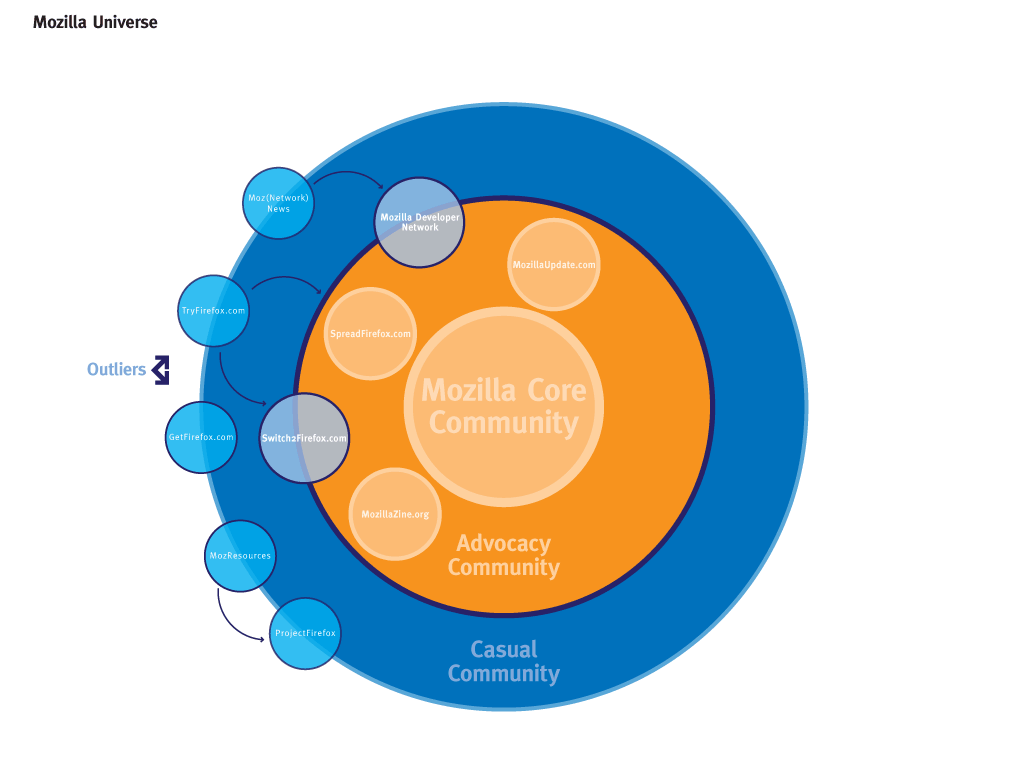
When I was at and planning out our adoption strategy, I followed very similar principles (though I didn’t have a catchy framework like “Pinko” at the time). By seeing the existing community as made up of concentric circles of enthusiastics and early adopters, my goal was to create a black hole suction of sorts deeper into the inner core community:
Mozilla Universe v1

My theory was that the more folks we could bring into the inner rings of the Mozilla community, the more devoted they’d become and the lower the incremental effort we’d need to exert to pull in more outliers, like their friends, coworkers and family members.

Tara’s argument very much mirrors this approach. By focusing your effort and outreach on a core constituency, just like in a presidential campaign (read: ), you’ll be enticing folks with a truly valuable service that those same folks can then turn around and preach about with more convincing passion, integrity and self-interest than you could… the very reason that the Spread Firefox campaign was so successful; it relied on concentric circles of true-believers to spread the word. For its part it only had to focus on continuing to build a great product and delivery community infrastructure to support its core constituency.

So when it comes to community barn-raising and product development, keeping your design and development efforts geared to a tightly knit core of enthusiasts is the best way to create the first drop that will ripple out to the wider audiences that your VCs are constantly (and damagingly) telling you to go after. There’s simply no better way to effectively and organically build out to a wider audience than taking the concentric circles approach.

On open letter to Blogger

bloggerformatsWith Blogger in the throes of a new beta cycle, it seems the ideal moment to get support into one of the more popular blogging platforms on the web.

With that goal in mind, I sent an open request letter to the Blogger-Help discussion group. No responses yet, but if you’re interested in seeing this happen, please follow up in whatever way you think might be most effective… tanks!

Hello,

Not sure to whom I should address this request, but I’m very excited about the Blogger Beta and that it represents an open opportunity to add support for microformatted content.

You can read more about microformats at microformats.org, but to summarize, microformats are community-developed standards for identifying certain kinds of information in webpages using your typical HTML tags and classes.

In particular, this is my wishlist of microformats that I would love to see Blogger support:

  • : okay, you already took care of this one, so kudos!
  • XFN: WordPress already supports this, and it’s especially useful for representing lists of friends in blogrolls.
  • rel-me: from the XFN family, being able to link to other pages on the web using rel=”me” creates an informal means of “claiming” other places where I publish online. Read about Ma.gnolia’s addition of rel-me.
  • : marking up personal profiles in hcard means that if I add personal contact details, people can click a link to add me to their address book without any extra typing. I’ve done this on my main blog. Clicking the “Add me to your address book” link will convert the HTML content in that page into a .vcf file that most address book programs can recognize.
  • : In order to make it easy for my readers to add events that I’ve blogged about to their calendars (Google Calendar or others, like iCal), I can use hcalendar to mark up this information with a link to add the events to their calendar. Here’s an example.
  • hAtom: This one is fairly simple to implement since you’re already classing most of this information already. hAtom uses element names from Atom as class names. This allows people to subscribe to blogs directly, without the need to subscribe to RSS. You can read more about this.

Though the benefits may not seem immediately obvious to supporting microformats, the amount of effort required to add support is fairly minimal compared with other, more substantial features that you’re probably already working on. Furthermore, our community would be happy to help with the process of adding support to Blogger, validating your work and providing guidance along the way. This initiative is also not a commercial effort; rather, it represents the work of a large, distributed, worldwide community that wants to build out the value of the “lowercase semantic web” and to make data storage in web pages a reality.

In some respects, we are at a chicken-and-egg crossroads but the more support that we see for microformats in the wild, the more tool makers, publishers, browsers and other applications will reap the benefits of this effort to essentially modernize the web, incrementally building upon the existing infrastructure.

Thanks for your consideration and please let me know if there is any way that I can be of service.

Chris

SilverOrange looking for a designer

SilverOrange dude SilverOrange, the fine folks behind the Digg design and Mozilla dot org are looking for a new designer.

Personally I’d jump at the opportunity, but as you probably know, I have a source of prior employment.

What might be interesting to note is that my entire foray into Silicon Valley life came to fruition because of a post I read on Steven Garrity’s blog in August 2004 about Mozilla looking for volunteer designers. I replied, got pulled into their backend intranet doing design volunteer work, a few weeks later we pushed out Spread Firefox and the rest, as they say, is history.

So I’m just saying, this could be the opportunity that sets you off in whatever direction the fates have picked out for you.

P.S. And no, this doesn’t mean I’m starting a job board (heh). I’m just doin’ a favor for some friends.

CrossOver Beta brings PC apps to the Dock

IE6 on the Mac

My open source buddy-slash-analyst Raven Zachary (who also brought me news of the Green Phone) pinged me to tell me that CodeWeavers have launched the beta of , a full WINE environment port to OSX that lets you run Windows apps without… Windows! (…unlike Parallels which is a virtual machine.)

I wrote about this idea in July and it appears that the reality of OSX subsuming Windows is coming ever-closer.

Though many of the folks whoa are most excited about this are gamers, Raven’s screenshot proves how valuable and convenient this will be for Mac web developers who have been locked out of native Internet Explorer testing.

Oh, and pre-ordering saves you $20, gets you 3 months of extra service and a free upgrade to CrossOver Mac 6.0 (just an FYI).