I’m a bit late with this news, but since MarsEdit is my blogging tool of choice, I thought that I’d note that Newsgator has decided to sell MarsEdit to Red Sweater Software (Brent Simmons has more, as does Gus Mueller (former MarsEdit developer) ), makers of FlexTime. Here’s to a 2.0 release sooner than later!
Does it ever rain on the internet?
Trying to map natural phenomena to the digital…
“Rain.”
Does it ever rain online? Y’know, not so much like “water” or “precipitation” but the phenomenon of “moisture” condensing, rising up into the atmosphere, and then returning to the surface to distribute nutrients, replenish the environment, to wash away the residue of life unfolding.
….
What I’m also wondering about are those bottom-dwellers… like the sucker fish at the bottom of fish tanks in Chinese restaurants… do they exist online? …as part of the positive ecosystem — not like viruses or pests like spammers, but creatures that perform maintenance on the conditions of the environment.
And the two classes are: natural occurring phenomena and voluntary maintenance actors.
So I’m just wondering about this.. that’s all.
Under lock and key
Daniel Quinn has written about civilization and how agricultural farming is what has brought us to our current environmental predicament. In his books, particularly Ishmael and My Ishmael, he points out putting the food supply under lock and key (as opposed to being readily available for foraging) is a natural outgrowth of agriculture, given its surpluses and that our entire infrastructure is built around that condition.
Recently I’ve been reading his book Beyond Civilization, which, contrary to what you might think, is a treatise against civilization in general — not an advocation of improving civilization, but of an abandonment of the notion altogether, for in civilization, we find the memes that time and time again lead us down the path of exploitation and environmental desecration.
Rather than just continue building civilization in a different way, he advocates walking away — and developing a new model of making a living based on tribal economics.
While his vision is appealing to me, I’m stuck wanting to see massive change and revolution, sensing the urgency of our situation. On the other hand, no massive and complete upheaval will actually work, since inverting the triangle would simply result in another triangle.
Instead, and this is the way biological systems work, we need incremental change and new memes that shape our thinking and our approach to our reality.
I’ve been thinking about this lately and find that DRM and Intellectual Property Laws represent one side of Daniel’s Quinn’s story — and efforts like Coworking, BarCamp, microformats, open source and others represent, or at least have characteristics, of the other.
In particular, I question any institutional trend towards consolidation, crystallization, centralization or the locking up of naturally occurring resources or readily reproducible resources (like digital data). With much of my work, I’ve attempted to implement or at least follow the framework suggested by Andrius Kulikaukus in his “An Economy for Giving Everything Away”. I’ve also taken lessons from Daniel Quinn’s work and others, and have come to prefer a longer and more incremental approach to the changes that I want to see made real, and I think that this is the path of open source and biomimetic innovation.
Having visited BarCampLondon, I instantly see the value of making BarCamp open and proactively inclusive from the beginning. Retrospectively, I’m proud that there was no urge to trademark or lock down the name, the brand, the model or the community — as anathema to the spirit of BarCamp those actions would have been, they were choices that were made, either explicitly or implicitly, over time. And there are lessons to be had from our experiences.
On occasion, the notion of trademarking the BarCamp name has been brought up, primarily from a defensive perspective, to chill any attempts by “bad actors” or “corporate interests” from taking away from us that which we call our community, much CMP nearly did with their “Web 2.0” trademark. Now, I can tell you that I can understand the reasoning behind this and can sympathize with it. I can also state, quite certainly, that I’d rather the name be taken from us than to bring us back to centralization and the methods of enforcement and protection that I find so unseemly in a gift-based, community context.
Trademarks, patents and copyright all place upon the owners of such Rights obligations that do not beget community. As DRM are the economic shackles of genius, so I would not move to limit the bounds and possibilities that good actors within the community might do. That is not to say that we are immune from abuse, only that our priority should be the encouragement and promotion of proper and positive use.
To that end, we rely on a community of peers to uphold our values and principles, and do not outsource the responsibility of this work to a cathedral, a court of law, a foundation or other centralized establishment. We defer instead to the routing of the network and the creation of nodes in bearing shades of the original.
This is an ecosystem, we are the grid, this is walking away from civilization, this is rise of the tribes of BarCamp.
I’ll conclude with a quote from Daniel Quinn‘s Beyond Civilization, where he invokes an interesting word in describing “A new rule for new minds”:
We deeply believe in taking a military approach to problems. We proclaim a “war” on poverty. When that fails, we proclaim a “war” on drugs. We “fight” crime. We “combat” homelessness. We “battle” hunger. We vow to “defeat” AIDS.
Engineers can’t afford to fail as consistently as politicians and bureaucrats, so they prefer accedence to resistance (as I do). For example, they know that no structure can be made rigid enough to resist an earthquake. So, rather than defy the earthquake’s power by building rigid structures, they accede to it by building flexible ones. To accede is not merely to give in but rather to give in while drawing near; one may accede not only to an argument but to a throne. Thus the earthquake-proof building survives not be defeating the earthquake’s power by by acknowledging it — by drawing it in and dealing with it.
This is the path forward, and the path that I prefer to any kind of control, ownership or dictatorship. I believe that it also the one of the BarCamp community, and so long as we are able to accede to our environment and always respond to it positively, productively and optimistically, I think that we stand a chance to see the change realized that we wish to become.
Microformatting the Future of Web Apps
Update: I’ve updated my schedule corrections to include hcards for all the speakers, so besides adding the entire schedule to your calendar, you can now import all the speakers to your address book.
Lisa from FoWA notified me that she’s since incorporated my hcalendar changes into the official schedule. Nice!

I wanted to draw attention to the effort put into the schedule for the upcoming Future of Web Apps (which we’re in London for). One the surface, it’s a great looking schedule — under the hood, you’ll find microformats marking up the times of the sessions. A nice effort, to be sure, except that their effort lacks a certain… accuracy.
I point this out for two reasons: one, I’d love to see the schedule fixed so that you can download it into your calendar. Second, it serves as a good example of why the Microformats community has been wise to minimize the use of both hidden microformatted content as well as invisible meta data as much as possible.
To illustrate the problem, let me point out two important elements of the hcalendar microformat. These elements specify when an event begins and ends respectively. From the icalendar standard, these values are indicated by the DTSTART and DTEND attributes. For example, this code would indicate that an event starts on Feb 20th at 6pm in London:
<abbr class="dtstart" title="20070220T1800Z">6pm</abbr>
However, when viewed in a browser, it looks like this: 6pm, and taken out of context, that 6pm could happen on any day of any year in any timezone. By marking up that time with an ISO datetime in the context of an hcalendar object, we know exactly what time and in what timezone we’re talking about.
So, looking at the FoWA schedule, you don’t know it, but even though it looks like it’s offering all the right times and correct information in the human-facing data, delving into the microformatted data will reveal a very different agenda, specifically one that takes place in 2006 and goes backwards in time, with some events ending on the day before they started.
Again, they’re certainly to be commended for their efforts to microformat their schedule to make it easy to import and subscribe to, but they seem to have missed an opportunity in actually providing a computer-readable schedule.
Here are some things that need to be fixed on the schedule:
- All times need to be contained in <abbr> tags, not <span>s. This is a common error in marking up hcalendar, so watch for this one first.
- Second, the dates specified in the title attributes need to be 100% accurate; it’s better to have no data than incorrect data.
- Third, all start times should begin before the end times, unless you’re marking up the schedule for a time machine.
- I should point out that it would be useful if all people and organization were marked up as hcards, but that’s a separate matter.
- Lastly, it always helps to validate your basic XHTML and run your microformatted content through consuming applications like Operator, X2V or Tails to see if the existing tools can make sense of your data. If not, it won’t work for anyone else either.
I’ve gone head and corrected the schedule. I’d love the for the FoWA team to take these basic changes and incorporate them into their schedule, but I know they’re busy, so in the meantime, feel free download the schedule in ICS format using Brian Suda‘s X2V transform script.
Who’s who on Twitter

Jeff Barr posted a lazy web request for a better view of Twitter contacts and Wes Maldonado responded with a slick Greasemonkey script.
Well, not to be outdone by the scripting folks, I made two similar scripts for Stylish, a Firefox plugin that allows you to apply custom CSS on certain webpages (see what I did for Tangler a couple days ago).
To apply these styles, install the extension and then add either of these styles to Twitter.com:
.code { border: 1px solid #ccc; list-style-type: decimal-leading-zero; padding: 5px; margin: 0; }
.code code { display: block; padding: 3px; margin-bottom: 0; }
.code li { background: #ddd; border: 1px solid #ccc; margin: 0 0 2px 2.2em; }
No avatars
@-moz-document domain("twitter.com") {#friends {margin-top: 12px;}#friends a[rel=contact] {display:block;text-decoration: none !important;margin-bottom:3px;}#friends a[rel=contact] img {display:none;}#friends a[rel=contact]:after {content: attr(title);}}
With avatars
@-moz-document domain("twitter.com") {#friends a[rel=contact] {display:block;text-decoration: none !important;margin-bottom:3px;}#friends a[rel=contact] img {margin-right: 3px; text-decoration: none !important;}#friends a[rel=contact]:after {content: attr(title);}}
The business value of community

So yeah, explain the business value of community? That’s like explaining why breathing oxygen is a good idea for carbon-based lifeforms. If it’s not already built into your DNA, you’re on the way to the tarpits baby.
Fertilized Core Value and Rhizomatic Social Expansion
At CommunityNext yesterday, Fred apparently talked about networks having a Core Value that attracts and expand its membership.
In the case of Delicious, it’s Core Value is offering a place to store your bookmarks; with Flickr, it was photos. The social networking components were then activated by people creating and adding content out of self interest.
This theory makes some good sense and is one that, in scientific interests, is reproducible.
However, Tara asked Fred to explain Twitter, which seemingly has no obvious Core Value. Stumped, he promised to think on it and get back to her.
As a proponent of Twitter, I’d argue that it’s got a couple things going on — and a Core Value that only emerges after a certain critical mass is achieved. This is similar to IRC and will be something that Tangler and any other live communication vehicle has to address, since it’s Core Value is couched in a) active concurrent users and b) facility of access.
Twitter has succeeded without obvious Core Value of its own by being planted firmly in the rich soil of infrastructure products like cell phones and instant messaging networks that have strong Core Value of their own.
Specifically, Twitter started out as a way for bike messengers to answer the question “what are you doing right now?”. The obvious tool to create and send this message was the cell phone, and the easiest way to receive and consume these messages were as short text snippets — clearly as SMS’s delivered to those phones.
It was Twitter developer Blaine Cook‘s prepaid wireless plan that forced him to develop Jabber::Simple as a way of getting and sending updates using a lower cost and wider spread infrastructure (instant messaging). But again, this would not be possible if it weren’t for the last 10 years of soil preparation that lead him to build this. And it was also thanks to open source that he could build the simple extension to leverage the Core Value of the existing network.
Finally, the Twitter web interface and API, almost afterthoughts these days, cemented the geographic accessibility of the network for newcomers to explore and experience how Twitterers communicate with each other, and how social norms are developed and negotiated (for example, the addition of the @ reply convention), essentially exposing the derived Core Value of the constituents.
Now, I might also add that there’s a different kind of Network Effect going on here. It’s similar to the Bandwagon Effect, but smaller and more niche.
It’s what I might refer to as the Rhyzomatic Effect (named after rhizomes).
Hell, I even dreamed up a whole web service off this idea (except when I originally scoped it out, it was primarily for individuals, but now that I think about it, there’s no reason why the same utility couldn’t be made to work for small tribes of 2-3 people at a time. Hmm.)
My premise is that, in the case of projects that have no obvious innate Core Value for individual use, they can still grow in the rich soil that previous infrastructure has cultivated (Web 2.0 manure?) so long as that soil is rooted in social connectivity (like the biomorphic analogies? Yeah? Get used to it.). In such an environment, it’s simple for one or two members to venture beyond the conventional borders or uses of given tool or infrastructure device and gain additive value once they evangelize the tool to their social peers and get them to adopt the new use.
And, contrary to Metcalfe’s Law, it’s not necessarily true that every new member will benefit every other member equally, adding constant value the more who use it; it’s only when members of the same tribes join that others members of the same tribes see value, and only when there is a desire to explore socially that those other members begin to offer cumulative value to the network.
If I had time, I’d throw up some pretty graphs comparing Delcious, Flickr and Twitter’s Core Values shown over given time horizons, and then map that to different size social clusters or tribes, since, again, not every Twitter member wants to be connected to every other Twitterer or every new Twitterer who joins. Therefore, Core Value must be measured both from the traditional perspective of personal economic advantage (i.e. convenience in saving my bookmarks or storing photos online) as well as from the tribal/communal-cumulative advantage.
Higher purpose and conspiring with the universe

Evelyn Rodriguez picks up on Tara’s recent commentful thread on Higher Purpose and references Buckminster Fuller. I think I’ll add him to my list of heros.
“In 1927, at the age of 32, Buckminster Fuller stood on the shores of Lake Michigan, prepared to throw himself into the freezing waters. His first child had died. He was bankrupt, discredited and jobless, and he had a wife and new-born daughter. On the verge of suicide, it suddenly struck him that his life belonged, not to himself, but to the universe. He chose at that moment to embark on what he called “an experiment to discover what the little, penniless, unknown individual might be able to do effectively on behalf of all humanity.”
Oh, and this fits nicely with The Alchemist’s assertion that, should you let it, the universe will conspire in your favor.
Rituals of social networking
In considering the interaction design of a social web application, it’s important to remember that expediency and efficiency are not always allies. Indeed, the laborious act of “adding a friend” or “creating a group” can become sacrosanct experiences in the course of the development of one’s online self… and tasks that should not be trivialized down to the data level.
Instead, these kinds of flows should be crafted and architected to be noticed as part of the network’s rituals: i.e. those behaviors and actions that occur regularly enough to give rise to a kind of life in the network. When you’re online, those actions and (notifications of like, the same) are the closest thing to respiration you can offer… and without some kind of active respiration system, you’re likely to be left for dead.
A specific example:
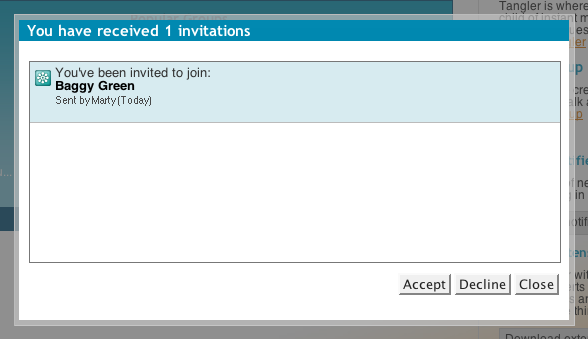
While on the surface this interface originally struck me as an efficient way to deal with a lot of group invitations, over time I’ve realized that it actually demeans the invitation acceptance ritual and that this design treats groups like commodities to be joined en masse, without much fore-thought, exploration or examination of the act about to be taken.
On the contrary, Flickr’s approach leaves the responsibility on the invitee to consider the validity of an invitation, and to explore the group before making a final decision to accept the invite.
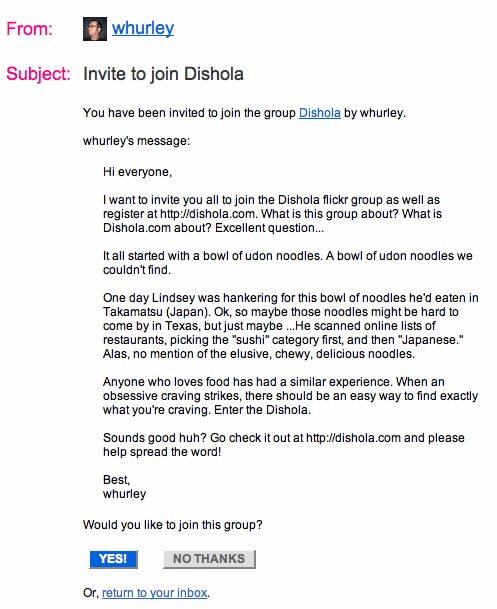
In this sense, you’re forced to read through the invitation in isolation and apart from any other decision, allowing you the space to consider it and choose to act positively, negatively or to defer until later. Like email, should you choose not to act this invitation will simply fade into the caverns of your inbox, outside of your daily environment, and not begging to be addressed. In the Tangler example, on the other hand, not making a choice will leave a residue on the interaction experience, forcing you to repeatable reconsider an invitation every time you view this interface leading to an intuitive mental stress that will likely cause people to downright avoid checking their invitations after the first 10 or 15 stack up.
The reality is that these subtle decisions in the interface design will greatly affect how the life of your community takes shape — and what ritual behaviors will be enjoyed and looked forward to as opposed to those that will be avoided because the mental tax over time gets too high. This is an area that I’d like to think more on — and start to positively collect ritual experiences that I enjoy on the networks of which I’m happy to call myself a member.
OpenID creates a foundation as Microsoft pledges support
You can read it around the web, but, hot on the heels of the creation of the OpenID Foundation, the news from the RSA Security conference is that Bill Gates has announced Microsoft’s intention to support OpenID 2.0.
Scott Kveton, our advisor at JanRain, has a summary and text of the announcement:
Microsoft to Work With the OpenID Community, Collaborating With JanRain, Sxip, and VeriSign
JanRain, Microsoft, Sxip, and VeriSign will collaborate on interoperability between OpenID and Windows CardSpace™ to make the Internet safer and easier to use. Specifically:
As part of OpenID’s security architecture, OpenID will be extended to allow relying parties to explicitly request and be informed of the use of phishing-resistant credentials.
Microsoft recognizes the growth of the OpenID community and believes OpenID plays a significant role in the Internet identity infrastructure. Kim Cameron, Chief Architect of Identity at Microsoft, will work with the OpenID community on authentication and anti-phishing.
JanRain, Sxip, and VeriSign recognize that Information Cards provide significant anti-phishing, privacy, and convenience benefits to users. Information Cards, based on the open WS-Trust standard, are available though Windows CardSpace™.
JanRain and Sxip, leading providers of open source code libraries for blogging and web sites, are announcing they will add support for the Information Cards to their OpenID code bases.
JanRain, Sxip and VeriSign plan to add Information Card support to future identity solutions.
Microsoft plans to support OpenID in future Identity server products.
The four companies have agreed to work together on a “Using Information Cards with OpenID” profile that will make it possible for other developers and service providers to take advantage of these technology advancements.
There’s no shortage of coverage, so I’ll just give you a run down of the players involved: Kim Cameron of Microsoft, Dick Hardt of SXIP, Michael Grave and David Recordon of VeriSign, Johannes Ernst of Netmesh, and Brad Fitzpatrick of LiveJournal.
What this means will be seen over time, but it does mean that a major player has shown their support for the protocol and for the community, making way for other, more reluctant parties, to step up and enter the arena.
It also means that Microsoft will be answering a major question about interface for the OpenID effort with their CardSpace work — and, if that work complies with their Open Specifications Promise, it will be advancing the anti-phishing efforts of the OpenID community years forward by bringing to the table a deployed, open specification for handling authentication in the browser.
While there will certainly be much work to be done to offer choice, this seems like a great opportunity to accelerate the user-centric identity efforts that have recently come to fruition.
 Factory Joe