Data banks, data brokers and citizen bargaining power

Sell to me

I wrote this this morning in a notebook as a follow up to my post yesterday… and since I don’t have time to clean it up now, I thought I’d present in raw, non-sensible form. Maybe there’s some value in a rough draft:

It’s like giving our money to a bank and having them turn around and sell our data to try to upsell us on loans and all kind of … oh wait, but the key difference is if we do get fed up, we can take our money out and go elsewhere, depriving the bank the ability to both target us with their partners’ ads and the ability to compound interest on our savings.

We need data brokers introduced into the system — organizations who are like safety deposit receptacles for our data — and who speak all APIs and actually advocate on our behalves for better service based on how “valuable” we are — this is necessary to top the scales in our favor — to reintroduce a balancing force into the marketplace because right now the choice to leave means dissing our friends — but if I’m not satisfied but still want to t talk to my friends, why can’t I be on the outside, but sending messages in? hell I’m willing to pay — in momentary access to my brokered personal profile — for access to my friends inside the silo. This is what Facebook is doing by shutting down so many accounts — it’s not personal — it’s protecting its business. They don’t want to become a myspace cesspool, succumb to empty profiles and Gresham’s Law — overrun with spam profiles and leeches and worthless profile data — a barren wasteland for advertisers who want to connect with that 8% of their customers who make up 32% of their revenue.

No it’s in data fidelity, richness, ironically FB took it upon themselves to weed out the bad from the good in their system-wide sweeps. Unfortunately they got it wrong a bunch of times. If Facebook allowed the export of data and became a data broker for its users — provided some citizen agency to its customers — there would be economic — as well as social — benefits to maintaining a clean and rich profile — beyond just expressiveness to one’s friends. For better or worse, FB users have a lot of benefit through the siloed apps of that F8 platform — but the grand vision should be closer to what Google’s marketing department christened “OpenSocial”… still though , the roles of banker and broker have yet to be made explicit and so we’ve leapt to “data portability” for nerds, forgetting that most people 1) don’t care about this stuff 2) are happy to exchange their data for services as long as their friends are doing it too 3) don’t want to be burdened with becoming their own libertarian banker! Dave Winer might want to keep everything in an XML file on his desktop, but I know few others who, IRL, feel the same way.

Thus concludes my rough notes.

So, if Facebook were perceived as a big Data Bank in the sky, how would that change things? Would people demand the ability to “withdraw” their data? Does the metaphor confuse or clarify? In any case, what is the role of data banks and data brokers? Is there a difference if the data container leverages the data for their own benefit? If they sell advertising and don’t provide a clear or universal means to opt-out? And what’s in the way of making more “benevolent” data vaults a reality — or how do we at least bring the concept into the discussion?

I have no personal interest the concept, only that’s a viable alternative to the siloed approach is missing from the discussion. And going back to the business models of OpenID and other identity providers… well, if any, that’s it. It’s like having a credit card with access to no credit — what’s the point? And OpenID becomes more valuable the more data capital it has access to. Or something like that.

Oh, and I’d like to quote something poignant that Anders Conbere said to me today in chat:

I was talking with my friend the other day and I tried to explain to him, that what I fear about facebook that I don’t fear about pretty much any other vendor is it’s continued developement as a competing platform to the web. a locked in, proprietary version and what I see, is just like Microsoft leveraged Windows as a “platform for application developement” facebook is doing that for web developement. what it offers developers is the simplicity and security of a stable developement environment at the cost of inovation because as we’ve seen, as market share grows, the ability to inovate decreases (since your success is tied to the backwards compatibility of your platform) and I see the possibility of facebook becoming a dominant platform for web application developement which will in turn lead to two decades of stagnation

So yeah, put that in your bonnet and smoke it. Or whatever.

Data portability and thinking ahead to 2008

So-called data portability and data ownership is a hot topic of late, and with good reason: with all the talk of the opening of social networking sites and the loss of presumed privacy, there’s been a commensurate acknowledgment that the value is not in the portability of widgets (via OpenSocial et al) but instead, (as Tim O’Reilly eloquently put it) it’s the data, stupid!

Now, Doc’s call for action is well timed, as we near the close of 2007 and set our sights on 2008.

Earlier this year, ZDNet predicted that 2007 would be the year of OpenID, and for all intents and purposes, it has been, if only in that it put the concept of non-siloed user accounts on the map. We have a long way to go, to be sure, but with OpenID 2.0 around the corner, it’s only a matter of time before building user prisons goes out of fashion and building OpenID-based citizen-centric services becomes the norm.

Inspired by the fact that even Mitchell Baker of Mozilla is talking about Firefox’s role in the issue of data ownership (In 2008 … We find new ways to give people greater control over their online lives — access to data, control of data…), this is going to be issue that most defines 2008 — or at least the early part of the year. And frankly, we’re already off to a good start. So here are the things that I think fit into this picture and what needs to happen to push progress on this central issue:

  • Economic incentives and VRM: Doc is right to phrase the debate in terms of VRM. When it comes down to it, nothing’s going to change unless 1) customers refuse to play along anymore and demand change and 2) there’s increased economic benefit to companies that give back control to their customers versus those companies that continue to either restrict or abuse/sell out their customers’ data. Currently, this is a consumer rights battle, but since it’s being fought largely in Silicon Valley where the issues are understood technically while valuations are tied to the attractiveness a platform has to advertisers, consumers are at a great disadvantage since they can’t make a compelling economic case. And given that the government and most bureaucracy is fulled up with stakeholders who are hungry for more and more accurate and technologically-distilled demographic data, it’s unlikely that we could force the issue through the legal system, as has been approximated in places like Germany and the UK.
  • Reframing of privacy and access permissions: I’ve harped on this for awhile, but historic notions of privacy have been out-moded by modern realities. Those who do expect complete and utter control need to take a look at the up and coming generation and realize that, while it’s true that they, on a whole, don’t appreciate the value and sacredness of their privacy, and that they’re certainly more willing to exchange it for access to services or to simply dispense with it altogether and face the consequences later (eavesdroppers be damned!), their apathy indicates the uphill struggle we face in credibly making our case.

    Times have changed. Privacy and our notions of it must adapt too. And that starts by developing the language to discuss these matters in a way that’s obvious and salient to those who are concerned about these issues. Simply demanding the protection of one’s privacy is now a hollow and unrealistic demand; now we should be talking about access, about permissions, about provenance, about review and about federation and delegation. It’s not until we deepen our understanding of the facets of identity, and of personal data and of personal profiles, tastestreams and newsfeeds that can begin to make headway on exploring the economic aspects of customer data and who should control it, have access to it,

  • Data portability and open/non-proprietary web standards and protocols: Since this is an area I’ve been involved in and am passionate about, I have some specific thoughts on this. For one thing, the technologies that I obsess over have data portability at their center: OpenID for identification and “hanging” data, microformats for marking it up, and OAuth for provisioning controlled access to said data… The development, adoption and implementation of this breed of technologies is paramount to demonstrating both the potential and need for a re-orientation of the way web services are built and deployed today. Without the deployment of these technologies and their cousins, we risk web-wide lock-in to vender-specific solutions like Facebook’s FBML or Google’s , greatly inhibiting the potential for market growth and innovation. And it’s not so much that these technologies are necessarily bad in and of themselves, but that they represent a grave shift away from the slower but less commercially-driven development of open and public-domained web standards. Consider me the frog in the luke warm water recognizing that things are starting to get warm in here.
  • Citizen-centric web services: The result of progress in these three topics is what I’m calling the “citizen-centric web”, where a citizen is anyone who inhabits the web, in some form or another. Citizen-centric web services, are, of course, services provided to those inhabitants. This notion is what I think is, and should, going to drive much of thinking in 2008 about how to build better citizen-centric web services, where individuals identify themselves to services, rather than recreating themselves and their so-called social-graph; where they can push and pull their data at their whim and fancy, and where such data is essentially “leased” out to various service providers on an as-needed basis, rather than on a once-and-for-all status using OAuth tokens and proxied delegation to trusted data providers; where citizens control not only who can contact them, but are able to express, in portable terms, a list of people or companies who cannot contact them or pitch ads to them, anywhere; where citizens are able to audit a comprehensive list of profile and behavior data that any company has on file about them and to be able to correct, edit or revoke that data; where “permission” has a universal, citizen-positive definition; where companies have to agree to a Creative Commons-style Terms of Access and Stewardship before being able to even look at a customer’s personal data; and that, perhaps most import to making all this happen, sound business models are developed that actually work with this new orientation, rather than in spite of it.

So, in grandiose terms I suppose, these are the issues that I’m pondering as 2008 approaches and as I ready myself for the challenges and battles that lie ahead. I think we’re making considerable progress on the technology side of things, though there’s always more to do. I think we need to make more progress on the language, economic, business and framing fronts, though. But, we’re making progress, and thankfully we’re having these conversations now and developing real solutions that will result in a more citizen-centric reality in the not too distant future.

If you’re interested in discussing these topics in depth, make it to the Internet Identity Workshop next week, where these topics are going to be front and center in what should be a pretty excellent meeting of the minds on these and related topics.

WP-Imagefit proportionally resizes images to fit your blog template

I’m happy to announce the release of my second ever WordPress plugin called . (My first, which I’ve neglected for sometime, is called WP-Microformatted-Blogroll).

WP-Imagefit is extremely simple and serves one purpose: to get images in blog posts to fit inside the columns that contain them. In fact, this plugin is used on this blog, so if you see ever images load wider than the column and then quickly snap to fit the container’s width, it’s this plugin that’s doing that.

I originally discovered this trick thanks to Oliver Boermans‘ NetNewsWire Ollicle Reflex style. Working together, he extracted the resizing code into a jQuery plugin called jquery.imagefit.js and made it available to me for use in my EasyReader NetNewsWire theme.

I had hacked it to work for my blog theme but decided that I should turn it into a WordPress plugin so I could use it elsewhere (and given that CSS’s max-width attribute not only wasn’t cross-browser, but also shrunk images horizontally, I needed a better solution). So, there you have it.

Go ahead and download it. Installation and setup is standard as long as you have an -compliant theme like K2 or .

I have a WordPress.org project page setup, the source is available (released under GPL), and if you want something to look at it, here’s the official homepage.

Feedback/feature requests/patches certainly appreciated and encouraged!

Privacy, publicity and open data

Intelligence deputy to America: Rethink privacy - CNN.com

This one should be a quickie.

A fascinating article came out of CNN today: “Intelligence deputy to America: Rethink privacy“.

This is a topic I’ve had opinions about for some time. My somewhat pessimistic view is that privacy is an illusion, and that more and more historic vestiges of so-called privacy are slipping through our fingers with the advent of increasingly ubiquitous and promiscuous technologies, the results of which are not all necessarily bad (take a look at just how captivating the Facebook Newsfeed is!).

Still, the more reading I’ve been doing lately about international issues and conflict, the more I agree with Danny Weitzner that there needs to be a robust dialogue about what it means to live in a post-privacy era, and what demands we must place on those companies, governments and institutions that store data about us, about the habits to which we’re prone and about the friends we keep. He sums up the conversation space thus:

Privacy is not lost simply because people find these services useful and start sharing location. Privacy could be lost if we don’t start to figure what the rules are for how this sort of location data can be used. We’ve got to make progress in two areas:

  • technical: how can users sharing and usage preferences be easily communicated to and acted upon by others? Suppose I share my location with a friend by don’t want my employer to know it. What happens when my friend, intentionally or accidentally shares a social location map with my employer or with the public at large? How would my friend know that this is contrary to the way I want my location data used? What sorts of technologies and standards are needed to allow location data to be freely shared while respective users usage limitation requirements?
  • legal: what sort of limits ought there to be on the use of location data?
  • can employers require employees to disclose real time location data?
  • is there any difference between real-time and historical location data traces? (I doubt it)
  • under what conditions can the government get location data?

There’s clearly a lot to think about with these new services. I hope that we can approach this from the perspective that lots of location data will being flowing around and realize the the big challenge is to develop social, technical and legal tools to be sure that it is not misused.

I want to bring some attention to his first point about the technical issues surrounding New Privacy. This is the realm where we play, and this is the realm where we have the most to offer. This is also an area that’s the most contentious and in need of aggressive policies and leadership, because the old investment model that treats silos of data as gold mines has to end.

I think Tim O’Reilly is really talking about this when he lambasts Google’s OpenSocial, proclaiming, “It’s the data, stupid!” The problem of course is what open data actually means in the context of user control and ownership, in terms of “licensing” and in terms of proliferation. These are not new problems for technologists as permissioning dates back to the earliest operating systems, but the problem becomes infinitely complex now that it’s been unbounded and non-technologists are starting to realize a) how many groups have been collecting data about them and b) how much collusion is going on to analyze said data. (Yeah, those discounts that that Safeway card gets you make a lot more money for Safeway than they save you, you better believe it!)

With Donald Kerr, the principal deputy director of national intelligence, taking an equally pessimistic (or Apocalyptic) attitude about privacy, I think there needs to be a broader, eyes-wide-open look at who has what data about whom and what they’re doing about — and perhaps more importantly — how the people about whom the data is being collected can get in on the game and get access to this data in the same way you’re guaranteed access and the ability to dispute your credit report. The same thing should be true for web services, the government and anyone else who’s been monitoring you, even if you’ve been sharing that information with them willingly. In another post, I talked about the value of this data — calling it “Data Capital“. People need to realize the massive amount of value that their data adds to the bottom line of so many major corporations (not to mention Web 2.0 startups!) and demand ongoing and persistent access to it. Hell, it might even result in better or more accurate data being stored in these mega-databases!

Regardless, when representatives from the government start to say things like:

Those two generations younger than we are have a very different idea of what is essential privacy, what they would wish to protect about their lives and affairs. And so, it’s not for us to inflict one size fits all, said Kerr, 68. Protecting anonymity isn’t a fight that can be won. Anyone that’s typed in their name on Google understands that.

Our job now is to engage in a productive debate, which focuses on privacy as a component of appropriate levels of security and public safety, Kerr said. I think all of us have to really take stock of what we already are willing to give up, in terms of anonymity, but [also] what safeguards we want in place to be sure that giving that doesn’t empty our bank account or do something equally bad elsewhere.

…you know that it’s time we started framing the debate on our own terms… thinking about what this means to the Citizen Centric Web and about how we want to become the gatekeepers for the data that is both rightfully ours and that should willfully be put into the service of our own needs and priorities.

Vulnerability in WP Super Cache v0.1

Twitter / Christian Heilmann: OK, supercache has fail. It allows you to even get to the root and create copies of every folder.

Sometime yesterday morning I logged into my TextDrive account to make some more changes to my blog template and noticed two odd folders in my blog root directory called rh4m4.t35.com and www.kolortavil.org. I believe that the folders were empty, but nevertheless, it was clear that someone had broken into my site.

I deleted the suspicious folders and quickly reviewed the changes I’d made the day before and realized that the culprit was probably wp-super-cache, a new WordPress plugin that I’d installed the night before. I went ahead and disabled and then deleted the plugin (taking care to delete the supercache folder in /wp-content/cache/) and notified Joyent customer support (transcript and notes here) and Donncha Caoimh, the developer. I also twittered about the incident.

Sometime later I saw that Stephanie Sullivan had replied to me letting me know that Tiffany Brown was having a similar experience (though with greater consequence) and a report in the WordPress forums. Both Kristie Wells from Joyent and Donncha got back to me, the former confirming my suspicion that it was some kind of PHP Injection vulnerability and the latter asking for additional information.

This morning I found Chris Heilmann’s post on the subject confirming my concerns:

…Checking the folders created I found the same two injection attempts Tiffany mentioned. The caching allowed code injected as txt urls via “i” or “s” parameters to be executed.

In my case I found that half my server was mirrored into the supercache folder in the plugin’s cache folder. Not good.

I was happy to see that my etc folder and other more interesting bits were not reached yet before I deactivated the plugin. Right now I am playing grepmaster to see if there are some injections left. My action: deactived and deleted all caching plugins and their cache folders (best via SSH as FTP is a PITA with so many files).

I’ve now been in touch with Barry from Automattic and have followed up with Donncha, who have both been very patient and helpful in parsing through my logs trying to replicate the vulnerability.

The most likely culprit is an unquoted ABSPATH in v0.1 of the plugin. According to Donncha, “The ABSPATH part of the WPCACHEHOME definition could possibly have expanded when it was being written to the file. Unfortunately it wasn’t quoted so that may have done strange things to other variables like $cache_path. Barry says that the problem, though annoying, is just a bug and was likely just a misdirected attack on potentially vulnerably Drupal sites and that it won’t do more than create some benign directories in a WordPress install. Fortunately v0.3 of the plugin seems to have resolved the problem; meanwhile you can download or checkout the latest development version that corrects the ABSPATH issue.

I’ve written up my experience so far and let others know to watch out for irregularities if they choose to install the wp-super-cache plugin. I’m actually going to give the latest version another go and will report any problems here should I experience any.

While I’m at it, I’d like to point out the important role that Twitter and personal blogs played in tracking this down; and that Joyent support, Barry from Automattic and Donncha himself all played supportive roles in resolving this issue.

Coverflow for People

Address Book Coverflow v1

Ever since Apple bought Coverflow, I thought that it would make an awesome interface for browsing people. In fact, I had previously designed “people in the browser” for Flock to look something like this in the early days:

Friends Feed Reading

Of course, at the time, the design required a few things that we still lack, namely: 1) bigger default personal photos or avatars, 2) ubiquitous universal identifiers for people (this was before OpenID) 3) and free access to public data about people, typically found at the end of those identifiers.

Anyway, CoverFlow for people is something that I think could be a very powerful way of revealing “the ghosts in the machine” — across Leopard — or in interfaces generally. Imagine this kind of view showing up in Mail.app, Adium, iChat… where your friends, family and the rest get to update their own user pictures on a whim, and set their status and contact preferences in a way that visually makes sense. The new integrated Gtalk features in Gmail seem to be prioritizing your “Top 250”, so this is also something that could be added to the People Coverflow API without much trouble in order for the interface to scale accordingly. Anyone able to hack up a demo of this idea?

hCard for OpenID Simple Registration and Attribute Exchange

Microformats + OpenID

One of the many promises of OpenID is the ability to more easily federate profile information from an identity provider to secondary consumer applications. A simple example of this is when you fill out a basic personal profile on a new social network: if you’ve ever typed your name, birthday, address and your dog’s name into a form, why on earth would you ever have to type it again? Isn’t that what computers are for? Yeah, I thought so too, and that’s why OpenID — your friendly neighborhood identity protocol — has two competing solutions for this problem.

Unfortunately, both Simple Registration (SREG for short) and its potential successor Attribute Exchange (AX) go to strange lengths to reinvent the profile data wheel with their own exclusive formats. I’d like to propose a vast simplification of this problem by adopting attributes from the standard (also known as ). As you probably know, it’s this standard that defines the attributes of the and therefore is exceptionally appropriate for the case of OpenID (given its reliance on URLs for identifiers!).

Very quickly, I’ll compare the attributes in each format so you get a sense for what data I’m talking about and how each format specifies the data:

Attribute SREG AX vCard
Nickname openid.sreg.nickname namePerson/friendly nickname
Full Name openid.sreg.fullname namePerson n (family-name, given-name) or fn
Birthday openid.sreg.dob birthDate bday
Gender openid.sreg.gender gender gender
Email openid.sreg.email contact/email email
Postal Code openid.sreg.postcode contact/postalCode/home postal-code
Country openid.sreg.country contact/country/home country-name
Language openid.sreg.language pref/language N/A
Timezone openid.sreg.timezone pref/timezone tz
Photo N/A media/image/default photo
Company N/A company/name org
Biography N/A media/biography note
URL N/A contact/web/default URL

Now, there are a number of other other attributes beyond what I’ve covered here that AX and vCard cover, often overlapping in the data being described, but not in attribute names. Of course, this creates a pain for developers who want to do the right thing and import profile data rather than having folks repeat themselves yet again. Do you support SREG? AX? hCard? All of the above?

Well, regular people don’t care, and shouldn’t care, but that doesn’t mean that this isn’t a trivial matter.

Microformat glueInstead, the barriers to doing the right thing should be made as low as possible. Given all the work that we’ve done promoting microformats and the subsequent widespread adoption of them (I’d venture that there are many million hcards in the wild), it only makes sense to leverage the upward trend in the adoption of hcard and to use it as a parallel partner in the OpenID-profile-exchange dance.

While AX is well specified, hCard is well supported (as well as well-specified). While AX is extensible, hCard is too. Most importantly, however, hcard and vcard is already widely supported in existing applications like Outlook, Mail.app and just about every mobile phone on the planet and in just about any other application that exchanges profile data.

So the question is, when OpenID is clearly a player in the future and part of that promise is about making things easier, more consistent and more citizen-centric, why would we go and introduce a whole new format for representing person-detail-data when a perfectly good one already exists and is so widely supported?

I’m hoping that reason and sense will prevail and that OpenID and hCard will naturally come together as two essential building blocks for independents. If you’re interested in this issue, please blog about it or express your support to specs@openid.net. I think the folks working on this spec need to hear from folks who make, create, build or design websites and who recognize the importance and validity of betting on, and support and adopting, microformats.

OpenSocial and Address Book 2.0: Putting People into the Protocol

Obey by Shepard FaireyI wonder if Tim O’Reilly knows something that he’s not telling the rest of us. Or maybe he knows something that the rest of us know, but that we haven’t been able to articulate yet. Who knows.

In any case, he’s been going on about this “Address Book 2.0for awhile, and if you ask me, it has a lot to do with Google’s upcoming announcement of a set of protocols, formats and technologies they’ve dubbed OpenSocial.

[Aside: I’ll just point out that I like the fact that the name has “open” in it (even if “open” will be the catchphrase that replaces the Web 2.0 meme) because it means that in order to play along, you have to be some shade of open. I mean, if Web 2.0 was all about having lots of bits and parts all over the place and throwing them together just-in-time in the context of a “social” experience, then being “open” will be what separates those who are caught up and have been playing along from those who have been asleep at the wheel for the past four years. Being “open” (or the “most” open) is the next logical stage of the game, where being anything other than open will be met with a sudden and painless death. This is a good thing™ for the web, but remember that we’re in the infancy of the roll-out here, and mistakes (or brilliant insights) will define what kind of apps we’re building (or able to build) for the next 10 years.]

Let me center the context here. A few days ago, I wrote about putting people in the protocol. I was talking about another evolution that will come alongside the rush to be open (I should note that “open” is an ongoing process, not an endpoint in and of itself). This evolution will be painful for those who resist but will bring great advantage to those who embrace it. It’s pretty simple and if you ask me, it lies at the heart of Tim’s Address Book 2.0 and Google’s OpenSocial; in a word, it’s people.

Before I get into that, let me just point out what this is not about. Fortunately, in his assessment of “What to Look for from Google’s Social Networking Platform“, David Card at Jupiter Research spelled it out in blindingly incorrect terms:

As an analyst who used to have the word “Unix” on his business card, I’ve seen a lot of “open” “consortia” fail miserably. Regular readers know my Rule of Partnership: For a deal to be important, two of the following three must occur:

– Money must change hands
– There must be exclusivity
– Product must ship

“Open” “consortia” aren’t deals. That’s one of the reasons they fail. The key here would be “Product must ship.”

This completely misses the point. This is why the first bubble was so lame. So many people had third-world capital in their heads and missed what’s new: the development, accumulation and exchange of first-world social capital through human networks.

Now, the big thing that’s changed (or is changing) is the emphasis on the individual and her role across the system. Look at MyBlogLog. Look at Automattic’s purchase of Gravatar. Look at the sharp rise in OpenID adoption over the past two years. The future is in non-siloed living man! The future is in portable, independent identities valid, like Visa, everywhere that you want to be. It’s not just about social network fatigue and getting fed up with filling out profiles at every social network you join and re-adding all your friends. Yeah, those things are annoying but more importantly, the fact that you have to do it every time just to get basic value from each system means that each has been designed to benefit itself, rather than the individuals coming and going. The whole damn thing needs to be inverted, and like recently rejoined ant segments dumped from many an ant farm, the fractured, divided, shattered into a billion fragments-people of the web must rejoin themselves and become whole in the eyes of the services that, what else?, serve them!

Imagine this: imagine designing a web service where you don’t store the permanent records of facets of people, but instead you simply build services that serve people. In fact, it’s no longer even in your best interest to store data about people long term because, in fact, the data ages so rapidly that it’s next to useless to try to keep up with it. Instead, it’s about looking across the data that someone makes transactionally available to you (for a split second) and offering up the best service given what you’ve observed when similar fingerprint-profiles have come to your system in the past. It’s not so much about owning or storing Address Book 2.0 as much as being ready when all the people that populate the decentralized Address Book 2.0 concept come knocking at your door. Are you going to be ready to serve them immediately or asking them to fill out yet another profile form?

Maybe I’m not being entirely clear here. Admittedly, these are rough thoughts in my head right now and I’m not really self-editing. Forgive me.

But I think that it’s important to say something before the big official announcement comes down, so that we can pre-contextualize this and realize the shift that’s happening even as the hammer drops.

Look, if Google and a bunch of chummy chums are going to make available a whole slew of “social graph” material, we had better start realizing what this means. And we had better start realizing the value that our data and our social capital have in this new eco-system. Forget page views. Forget sticky eyeballs. With OpenID, with OAuth, with microformats, with, yes, with FOAF and other formats — hell with plain ‘ol scrapable HTML! — Google and co. will be amassing a social graph the likes of which has yet to be seen or twiddled upon (that’s a technical term). It means that we’re [finally] moving towards a citizen-centric web and it means great things for the web. It means that things are going to get interesting, for Facebook, for MySpace, for Microsoft, for Yahoo! (who recently closed 360, btw!) And y’know, I don’t know what Spiderman would think of OpenSocial or of what else’s coming down the pipe, but I’m sure in any case, he’d caution that, with great power comes great responsibility.

I’m certainly excited about this, but it’s not all about Google. Moreover, OpenSocial is simply an acknowledgment that things have to (and have) change(d). What comes next is anyone’s guess, but as far as I’m concerned, Tim’s been more or less in the ballpark so far, it just won’t necessarily be about owning the Address Book 2.0, but what it means when it’s taken for granted as a basic building block in the vast clockwork of the open social web.

Site-specific browsers and GreaseKit

GreaseKit - Manage Applications

There’s general class of applications that’s been gaining some traction lately in the Mozilla communities built on a free-standing framework called .

The idea is simple: take a browser, cut out the tabs, the URL bar and all the rest of the window chrome and instead load one website at a time. Hence the colloquial name: “site specific browser”.

Michael McCracken deserves credit for inspiring interest in this idea early on with his Webmail app, that in turn lead to Ben Willmore’s Gmail Browser application. Both literally took WebKit — Apple’s open source rendering engine (like Mozilla’s engine) — had it load Gmail.com and released their apps. It doesn’t get much more straight-forward than that.

For my own part, I’ve been chronically the development of Site-Specific Browsers from the beginning, setting up the WebKit PBWiki and releasing a couple of my own apps, most recently Diet Pibb. I have a strong belief that a full featured rendering engine coupled with a few client side tweaks is the future of browsers and web apps. You can see hints of this in Dashboard Widgets and Adobe’s AIR framework already, though the former’s launching flow conflicts with the traditional “click an icon in my dock to launch an application” design pattern.

Anyway, in developing my Site-Specific Browsers (or Desktop Web Apps?), I became enamored with an input manager for Safari called Creammonkey that allows you to run Greasemonkey scripts inside of Safari (ignore the name — Kato, the developer, is Japanese and English is his second language). An input manager works by matching a particular application’s .plist identifier and injecting its code (via SIMBL) into the application at run-time, effectively becoming part of the host application, in turn giving it access to all the application’s inner workings. When it comes to a rendering engine, it’s this kind of injection that allows you to then inject your own CSS or Javascript into a webpage, allowing you to make whatever modifications you want.

This is what Creammonkey did for Safari. And thank god it was open source or else we never would have ended up with today’s release of the successor to Creammonkey called GreaseKit.

Let me step back a little.

When I found out about Creammonkey, I contacted Kato Kazuyoshi, the developer, and told him how excited I was about what he had created.

“But could I use this on Site-Specific Browsers?” I wanted to know.

In broken English he expressed his uncertainty and so I went about hacking it myself.

I ended up with a crude solution where I would recompile Creammonkey and aim it at a different application every time I wanted to make use of a different Greasemonkey scripts. It was tedious and didn’t really work the way I envisioned, but given my meager programming skills, it demonstrated the idea of Site-Specific Browsers with Site-Specific Hacks.

I called this collection of site-specific scripts with a properly crafted Input Manager a “GreaseKit” and let the idea sit for a while.

Some time later, Kato got in touch with me and we talked about rereleasing Creammonkey with the functionality that I envisioned and a new name. Today he released the results of that work and called it GreaseKit.

I can’t really express how excited I am about this. I suspect that the significance of this development probably won’t shake the foundations of the web, but it’s pretty huge.

For one thing, I’ve found comparable solutions (Web Runner) clunky and hard to use. In contrast, I’m able to create stand-alone WebKit apps in under 2 minutes with native Apple menus and all the fixins using a template that Josh Peek made. No, these apps aren’t cross-platform (yet), but what I lose in spanning the Linux/PC divide, I gain in the use of , Apple’s development environment, and frankly a faster rendering engine. And, as of today, the use of Greasemonkey scripts centrally managed for every WebKit app I develop.

These apps are so easy to make and so frigging useful that people are actually building businesses on them. Consider Mailplane, Ruben Bakker’s Gmail app. It’s only increments better than McCracken’s WebMail or Willmore’s Gmail Browser, but he’s still able to charge $25 for it (which I paid happily). Now, with GreaseKit in the wild, I can add all my favorite Greasemonkey scripts to Mailplane — just like I might have with Firefox — but if Gmail causes a browser crash, I only lose Mailplane, rather than my whole browser and all the tabs I have open. Not to mention that I can command-tab to Mailplane like I can with Mail.app… and I can drag and drop a file on to Mailplane’s dock icon to compose a new email with an attachment. Just add offline storage (inevitable now that WebKit supports HTML5 client-side database storage) and you’ve basically got the best of desktop, web and user-scriptable applications all in one lightweight package. I’ll have more to write on this soon, but for now, give GreaseKit a whirl (or check the source) and let me know what you think.

And you wonder why people in America are afraid of the Internet

Ladies and gentlemen, I would like to present to you two exhibits.

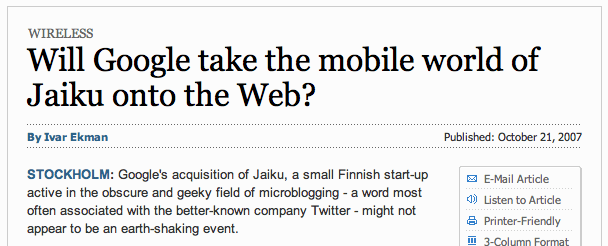
Here is Exhibit A from today’s International Herald Tribune:

Will Google take the mobile world of Jaiku onto the Web? - International Herald Tribune

In contrast (Exhibit B) we have the same exact article, but with a completely different headline:

Google’s Purchase of Jaiku Raises New Privacy Issues - New York Times

Now, for the life of me, I can’t figure out how the latter is a more accurate or more appropriate title for the article, which is ostensibly about Google’ acquisition of Jaiku.

But, for some reason, the editor of the NY Times piece decided that it would — what? — sell more papers? — to use a more incendiary and moreover misleading headline for the story.

Here’s why I take issue: I’m quoted in the article. And here’s where the difference is made. This is how the how the article ends:

“To date, many people still maintain their illusion of privacy,” he said in an e-mail message.

Adapting will take time.

“For iPhone users who use the Google Maps application, it’s already a pain to have to type in your current location,” he said. “‘Why doesn’t my phone just tell Google where I am?’ you invariably ask.”

When the time is right and frustrations like this are unpalatable enough, Mr. Messina said, “Google will have a ready answer to the problem.”

Consider the effect of reading that passage after being lead with a headline like “Google’s Purchase of Jaiku Raises New Privacy Issues” versus “Will Google take the mobile world of Jaiku onto the Web?” The latter clearly raises the specter of Google-as-Big-Brother while ignoring the fallacy that privacy, as people seem to understand it, continues to exist. Let’s face it: if you’re using a cell phone, the cell phone company knows where you are. It’s just a matter of time before you get an interface to that data and the illusion that somehow you gave Google (or any other third party) access to your whereabouts.

I for one do not understand how this kind of headline elevates or adds to the discourse, or how it helps people to better understand and come to gripes with the changing role and utility of their presence online. While I do like the notion that any well-engineered system can preserve one’s privacy while still being effective, I contend that it’s going to take a radical reinterpretation of what we think is and isn’t private to feel secure in who can and can’t see data about us.

So, to put it simply, there are no “new” privacy issues raised by Google’s acquisition of Jaiku; it’s simply the same old ones over and over again that we seem unable to deal with in any kind of open dialogue in the mainstream press.