XING adds support for microformats

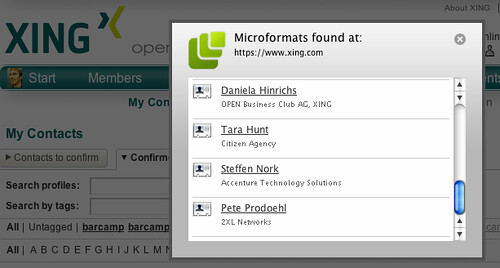
XING adds support for hCard (by factoryjoe)

The popular-cum-controversial professional networking site formerly-known as OpenBC recently relaunched with a new name and design with wide support for .

Tara first spoke with Daniela about implementing microformats ages ago and in follow up emails and blog posts, we encouraged and worked out various strategies (pro bono, mind you) around their microformats implementation. They’ve started basic with support for hCard and I hope that over time, they’ll add support for , , and .

Various extensions and web services can now detect private contacts in your XING account and add them to your address book or perform additional functions.

This work follows LinkedIn eventually adding support for hCard and hResume — work that, just maybe, we had something to do with as well. 😉

Hopefully XING’s support of microformats will make Sebastian happy for now, though it seems like he’s still a bit skeptical (though Google Translate didn’t help me much with his post).

Microformats in Drupal group formed

Drupal + Microformats (by factoryjoe)In a very promising step, it looks like that venerable CMF Drupal is beginning to take on the process of becoming microformatted with the creation of the Microformats in Drupal group.

The original use of microformats came in the Upcoming.org module (I believe) but now it seems clear that there are many more places throughout Drupal that could benefit from microformats, including on the content creation side.

With word that OpenID support will be added to Drupal Core in version 6 (a module is already available for 4.7), if we see the addition of hcard for profiles and XFN for representing social relationships in Drupal, we may finally be moving towards a more decentralized, open-source network of socially adept web properties.

Microformats + Flash: Who knew?

Microformats in YourMinis

One aspect of microformats that’s not been widely discussed or perhaps even considered is their interaction with Flash apps like YourMinis… you might be guffawing there, but fer real — it’s not just shiny shiny!

Microformats in YourMinisOk, so check this out. Go grab the YourMinis extension (recently updated!) and install it in Firefox. Restart, as usual, and now, whenever you’re on a page with microformatted content, you can launch the extension to “suck out” the data and toss it into your app of choice…

It only gets better from here as YourMinis can be used to unify your experience across sites… So if you thought that semantic web is only good for HTML, well, guess again… especially with the Adobe-Mozilla deal in place, expect more very interesting developments in the microformats-slash-rich-interface department very soon.

Last.fm adds support for hCalendar

Last.fm adds microformats

Guillermo Esteves has notified me that another site has added microformats under the hood — and, just like Apple’s dotMac Webmail, for password-protected content.

They don’t mention it, but this means that you can easily add concert listings on Last.fm, complete with recommended gigs to your calendar without breaking a sweat (or a finger).

They let you add gigs, but what’s missing is the ability to point at an Upcoming, Eventful or Yahoo! Local URL and pull in the microformatted content to create a subscription to the existing event.

Ya dig?

Internet Explorer 8.0 will support microformats

Microformats + Internet ExplorerWe now have confirmation that something that many of us in the community have suspected for some time (owing to Ray Ozzie’s Live Clipboard demo): that upcoming versions of Internet Explorer, expected some time in the next 12-18 months, will include support for microformats.

This, apparently, is straight from Chris Wilson, the new platform architect for IE:

“Mash-ups will continue to drive innovation. Componentization and semantic tagging of data will be supported,” Wilson told the Ajax Experience crowd. Wilson touted the harnessing of microformats, like Microsoft has done with its Live Clipboard effort, as “real world stuff” that will “make the Web much more usable.”

“Microformats add meaning to content in HTML,” Wilson said.

With discussions around support for microformats in Firefox 3, and Apple showing strong support for microformats as well, it’s only a very short amount of time before we can move on from the “so who’s using microformats?” question to “okay, so now what can we do with them?”

Apple embraces microformats in new .Mac webmail

Apple .Mac webmail supports hcard

If you’ve been playing with the new .Mac webmail application, something under the surface very significant is present, but you’d probably never realize it. In fact, if it weren’t good works like Jon Hicks’ expose-mf.css browser stylesheet (view the above image without the stylesheet), you’d probably have no idea that beneath the surface, Apple was quietly giving a nod to an upstart open source community.

Given the source code that I’ve been provided, I can confirm that Apple has indeed added support for in .Mac webmail, though not without a few errors (notably the ‘n’ optmization).

The significance of this can certainly be understated at this point, as few applications are built to take advantage of microformats browser-side (adding address cards that are already in your address book to your address book doesn’t make much sense) however, with Greasemonkey and other ideas like making the rounds (okay, so I came up with GreaseKits), we can count this as yet another feather in our cap as more and more large vendors make their web properties more semantically rich, opening up possibilities previously inaccessible given the sheer cost of maintaining one-off scrAPI techniques.

Now when you write a script to parse, augment, enhance or “user-interface-ize” microformatted content, it will work everywhere that microformats show up — not just one site at a time. With Firefox 3 looking to add support for microformats, it’s positive support by folks like Apple that will provide fertile ground for what the next generation of mashable web services looks like.

Writing history: Technorati adopts OpenID

Technorati adds support for OpenID

In an excellent sign of what’s surely to come, Technorati has adopted , at least for the moment, to claim your blog. This is a good first start and public display of support for this grassroots authentication protocol developer by Brad Fitzpatrick of LiveJournal, but until they fully support it to login to your actual Technorati account, this move serves only to whet the appetite.

But Technorati’s support does deserve recognition, as it is still early in the days of distributed single sign-on. Furthermore, the issues around remote login are many and require the involvement of and efforts from a wide range of diverse folks to help push through viable solutions for the myriad interface, user flow and communication challenges that this emerging standard brings with it.

As Ian Kallen of Technorati points out, there are still a number of issues to be resolved, chief among them:

I’m well aware of the concerns about phishy user interface vulnerabilities. The idea of logging in without a password may seem weird.

But that concern in and of itself should not prevent the continued building out of the OpenID network, especially as some smart folks are working on these, and other, thorny issues.

There are two things worth mentioning here as well.

First is that there was an agreement (perhaps a gentleperson’s agreement only) that stated that once Technorati added support for OpenID, LiveJournal would add support for microformats. Whether blog claiming constitutes “support for OpenID” as was intended by the offer is unclear, but it would be a rather positive development if LiveJournal did add support for , and other microformats.

Second, and more importantly, this example demonstrates the potential (I hate to say it) “longtail” value of support a decentralized authentication protocol like OpenID.

Consider this: let’s say that you blog on Blogger or on Yahoo! 360 or on MSN Spaces… as you probably know, each of the majors has their own authentication protocol (Google’s GAuth, Yahoo!’s BBAuth and Microsoft’s CardSpace, respectively). No doubt Technorati could add support claiming your blog using those protocols, no problem. But let’s say that you don’t want to play in one of those three de facto identity silos… what if you’re building your own independent blogging platform and want to offer authentication not provided by one of the Big Three? What are your options? What if you also want to use that same protocol to allow your users to have one login account across your other products?

Well, OpenID is designed to serve that purpose. In fact, you can run your own identity provider without needing to come close to the big three… and yet if did want to support them, work is being done (more thorny work I might add) to unify all your accounts into one OpenID that supports the big three. It’s highly unlikely, meanwhile, for the big three to do the same on their systems (for various appropriate reasons).

But here’s the thing: OpenID provides independents — individuals and small businesses — a way to play in the big leagues like the big guys without having to build the same kind of massive account infrastructure that they have. Furthermore, owing to the network effects of this standard, the more folks who consume and port around OpenIDs, the more valuable the network.

This is why we promote OpenID to all of our clients — as each one adds support for OpenID, all of our client’s clients (our real customers) can then log in and share their accounts across the services that our clients are building. This is a fundamental key to the non-zero sum economics that we preach! People like flexibility, they like control over their data and they like to be in charge of their identity and its destiny. That’s just good business. And the more that we decentralize identity and authentication services, the closer that control moves to the individual.

In the meantime, there is still much work to be done. But these small steps make a world of difference in terms of underscoring the value of this work.
Making microformats even more visible

Leftlogic Bookmarklet

Hot on the heals of Jon Hick’s CSS work, the folks at Left Logic have created a cool bookmarklet for revealing microformats in situ

I took their work one step further, uploaded the script to my server (to prevent malicious activity only) and made it possible for you to run the script on any page of my site, just by clicking the microcontent link in the footer. It’s still a bit buggy, but this work proves ever more the value of marking up your visible data in a way that makes it machine readable.

Bonus link: Sam Sethi points out Dealtagger — another hListing-based search engine!

Using Microformats by Brian Suda

Microformats Short Cuts

Well, we finally have a book, thanks to Brian “X2V” Suda. $10 for the downloadable PDF:

Microformats let you share structured information in HTML web pages. Although the information is visible to human readers–as it should be–software can also extract structured information. This Short Cut is a general introduction to the history of microformats and an explanation why these ideas are rocketing to the forefront of technology. It includes information and examples on how to add all of the popular microformats used and consumed today to your documents. Also included is discussion of where the idea behind microformats originated and why the microformats process is so open for everyone to contribute. With millions of instances of microformats on the Web, isn’t it about time to learn what it’s all about?