XING adds support for microformats

XING adds support for hCard (by factoryjoe)

The popular-cum-controversial professional networking site formerly-known as OpenBC recently relaunched with a new name and design with wide support for .

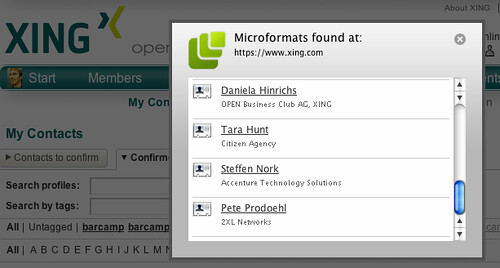
Tara first spoke with Daniela about implementing microformats ages ago and in follow up emails and blog posts, we encouraged and worked out various strategies (pro bono, mind you) around their microformats implementation. They’ve started basic with support for hCard and I hope that over time, they’ll add support for , , and .

Various extensions and web services can now detect private contacts in your XING account and add them to your address book or perform additional functions.

This work follows LinkedIn eventually adding support for hCard and hResume — work that, just maybe, we had something to do with as well. 😉

Hopefully XING’s support of microformats will make Sebastian happy for now, though it seems like he’s still a bit skeptical (though Google Translate didn’t help me much with his post).

Welcome to the Neighborhood 2.0

VOX header

Surely you’ve heard by now that Six Apart’s new neighborhood platform VOX has launched.

I really like it. In fact, it’s the first online “place” that my mom’s signed up with, who was shortly followed by my brother (who found me initially on Facebook and I cajoled him into joining VOX).

Now that they’re both on it, I actually feel pretty comfortable about them giving it a go without me chaperoning them along.

Don’t get me wrong… I mean, there’s a bit of complexity in VOX, but I kind of feel like, if they play around a little — with the teasers that incite you to actually contribute and connect (suggest a neighbor feature on the invite page is genius) — they might just get into all this “Web 2.0” stuff I’ve been yammering on to them about for ages.

So now, imagine going home for Thanksgiving and rather than having to explain “feeds” or “Flickr”, we can just follow up on posts that they read but never commented on… or photos of my neighbor’s that they liked… Imagine using VOX, with its facile design and attention to detail, to finally connect with folks who normally could care less about this stuff.

Yes, finally.

It’s funny, but lots of people talk about “designing for Grandma” or “soccer moms” or other supposedly technically inept audiences (though, who in reality are often just as — if not moreso — savvy than the folks making such comments). But I think VOX has gone further than many who have come before and have successfully built a product and a community that I wouldn’t mind introducing my mom to (in fact, I did just that) and who I wouldn’t mind taking her through so that I knew it made sense and so that she could get the most out of her time spent on it.

In fact — and this is critical — once she’s set up and off on her own, I trust VOX to not get in her way or insult her intelligence. Perhaps I’m belaboring the point, but there are just so many nuances that make VOX feel friendly and worth working with that it’s important to point out that VOX is, above all, an excellent example of applied restraint and the execution of clear intention.

The one geeky thing I’ll add is that I’m eagerly awaiting OpenID integration so that we can start pushing forward with making the experience of grassroots identity consolidation as easy and good looking as VOX.

Go phish: Tom gets annoyed

MySpace PhishedPhictional character Tom of MySpace (maybe the prodigal son of Tom “We’ll leave the light on for ya” Bodett of Motel 6? ) is annoyed at a recent slew of spammers … accessing … your account … using it to market their junk to your friends via YOUR bulletins and YOUR comments.

Whoa there, you *almost* sound human, Tom. WTFLOL!

Tell me Tom, how did they get my password?

now how did they get your password? it’s called phishing. somewhere on myspace you clicked on a link, profile, page – something, and you saw the myspace login page. but wait – it wasn’t really the myspace login page. it was a FAKE LOGIN PAGE. that fake page was created by a spammer who is waiting for you to enter your email and password. once you’ve done that, he’s stores your info. then he runs scripts to send bulletin spam and comment spam on myspace.

Thanks for clearing that up. I’m glad you’ve got things under control and are growing the service. It’s not like this is the first time those phishy people have attacked us.

But kudos to you, Tim — you da man, Tom-Tom. I know my future is secure with you on the watch.

Putz.

Dodgeball goes Gauth, reveals GOOG’s masterplan to p0wn your ass

Did you know that Dodgeball's been assimilated?

Don’t say I didn’t warn you, but now when you try to log into your favorite neighborhood spyware, you’ll be greeted by a prompt to login with either your old skool Dodgeball account credentials or your Gauth account (the one that you use for Docs, Gmail, Gcal, Orkut, or other Google Services like YouTube (whoops — did I just say YouTube?).

Should you choose to login with your Dodgeball account, you’ll then be asked what your Gauth account isagain… or to create a new one. I chose to eff it and just merge my accounts (hoping that there’s an export of my checkins to Google Earth). Now I can manage Dodgeball from Google (note the last service):
Dodgeball as Google Service

The BorgSo here’s an interesting theory. Or maybe a foretelling of the inevitable. But clearly everything that Google buys, it will, somehow, someday, assimilate. Just like Teh Borg a generation before it.

I mean, from a business perspective, it does make sense. Yahoo! at least had the sense to make it utterly optional for Flickr and Upcoming users to use or create a Yahoo account for logging in (though they’ve recently backslid into pushing straight-up Y! Auth at Flickr).

So in light of the GooTube buy-out, what’s interesting about this Dodgeball stitchover is what happens if they do the same to YouTube (which, of course, they will, giving them a lump sum portion of the nearly 20M monthly uniques as new or merged accounts under their proprietary authentication system). …Which then, of course, can be used at other Google Authenticated sites. But hey, how useful are those accounts on sites that don’t use their system? Yeah, about as a good as a false username and an incorrect password: utterly useless.

Which leads me to pimping OpenID, the open grassroots alternative I’ve previously discussed. If Google opted to interop with (or help develop) this emerging standard, users would be centrally in control of their data — and able to rely on vendors that they choose to represent them — hell, even run their own identity server if that’s their wont — and take their data with them. And now is more critical than ever to raise these issues as the major players push , BBAuth and GAuth while independent identity projects struggle to keep it together and muster their collective will in crafting a standard that keeps users’ rights and interests squarely at the fore.

Thus with Google standing guard squarely between me and more and more of the services that I use, I’m starting to bear witness to the rise of a very insidious environment — where, heck, the kids’ll just keep following the into unknown territory until Google single-handedly locks’em all up in its walled-garden-silo, never to escape with their data or their friends again (that’s not evil, is it?) — or at least that’s what it looks like from here, given their culture of secrecy and expediency in converting existing login systems to their own (Writely, Dodgeball, Blogger, Picasa, Google Earth, etc).

But hey, I still remain hopefully naive while decidedly skeptical; if it’s not Google that gets there first, maybe it’ll be Apple with their patent on transportable identities. And, if there’s something you want to do about it in the meantime, if you’re running WordPress, go ahead and grab the new . Perhaps if we take the identity matter into our own hands and do something about it first, they’ll have no choice but to keep the gate to their walled gardens, at the very least, unlatched.
The tamagotchi of Web 2.0

Celly is my tamagotchi

So there were a couple of announcements from Twitter today (like status permalinks), and one half-mentioned Celly — the cutest and most social thing to come out of Web 2.0 leveraging a newly minted API.

As Tara likes to say, “Ev Williams is my Tamagotchi!”

Well, now the whole Twitter community can be your Tamagotchi with Celly.app.

Download it direct or grab the source.

This is just another neat WebKit app made possible by the work of Josh Peek, Chip Cuccio and others.

A solution for Google Calendar on Blackberry 8700c

Gah, finally!

I meant to write about this ages ago, but now that Version 1.1 is out thanks to Thomas Oldervoll, I can happily report that I have Google Calendar working on my Blackberry 8700c!

For awhile I was using 30Boxes Mobile as my Gcal proxy, but no longer! I can unhide that Calendar app on my Blackberry desktop now that I’ve got the open-source Gcalsync running!

Cut-to-the-chase instructions: load up wap.gcalsync.com on your Blackberry and install the signed version. Run the app. Choose Sync, type in your Google username and password (no idea how trustworthy this thing is) and hit Save. The Sync should commence.

Now, I had some issues with this, but it’s better than nothing, so I can only hope that Thomas will continue his work (or you’ll pitch in).

And hey, if it works for you, digg it.

A fresh face in people search, care of Sweden

Polar Rose

This isn’t new news, per se, but it’s still interesting to see that Riya 1.0 has some new competition (how’d’ya like that? Retroactive competition… heh!).

If you’ve been playing along, you’d know that Riya has moved towards general image search and away from exclusively focusing on cute-baby-face-image-indexing (I kid, I kid!). In fact, Munjal says it best:

As we announced in May we are heading in a different direction because users just didn’t want face recognition in their own photos as much as they wanted smarter web search. Starting next week and continuing for the next month or so we’ll post the gradual release of our new product that reluanches our efforts.

Contrary to Polar Rose founder Jan Erik Solem’s bombastic claim that their search engine … will be the first of its kind in the world, I am more optimistic about their approach of using a simple browser plugin to enable folks to casually point out faces in the images that they come across, effectively decentralizing the task and providing a much needed instant-incentive for folks who are specifically interested in this kind of information. I still wonder whether such efforts can ever really boil the web-wide ocean, but with similar efforts underway at Google, sooner or later, we are going to get to a better way to discover, explore and search rich media based on their content, not just where they were taken or when.

In the meantime, screenshots of the Polar Rose plugin are available for download.

Via Digg via Alex Hillman.