Dave Watanabe is at it again. The creator of NewsFireRSS and P2P app AcquisitionX has released a BitTorrent app called xTorrent whose interface looks strangely similar to BitRocket. Nevertheless, definitely worth a look.
Author: Chris Messina
Inventor of the hashtag. #1 Product Hunter. Techmeme Ride Home podcaster. Ever-curious product designer and technologist. Previously: Google, Uber, Republic, YC W'18.
Goplan supports microformats

I’ve been playing around with Goplan and really like the feature set so far. One of the invisible features that is now visible thanks to a post by Fred Oliveira is their support for microformats — namely hCalendar:
I’d like to take some time to highlight the icalendar integration and microformats support. We’ve been fans of the Microformats project for quite a while, and are working on bringing Microformat compability for events (in the calendar, as well as due tasks) and people. This allows us to provide developers with more ways to export project-related data. For more information on microformats, see the microformats project homepage.
This is smart development. Though it might not seem entirely obvious how Goplan users can take advantage of this small addition, over time I think we’ll see excellent integration with tools like Greasemonkey, browser scripts and user styles or rendering engines. Can OpenID support be far off?
Another fool leaves the Flock
 The title of this post might sound meaner than it really is, but I’m referring to the departure of Lloyd “Foolswisdom” Budd from Flock.
This is something I’ve known about for awhile (as well as Bart’s departure before it was made public), but Lloyd’s post does a pretty good job capturing what clearly was a tough decision with hundreds of photos from his stay at what some might call the yellow canary of Web 2.0.
Things for good for Lloyd and his new bride, however, and I’m excited to find out what’s next for them as they resettle in Victoria, BC.
And yeah, I presume that he’ll keep up with his masterful photography work and foodporn shots.
Rob “Lilo” Levin passes away
Scott Beale shared some rather sad and unfortunate news with me:
On the 12th September Rob Levin, known to many as Freenode’s lilo, was hit by a car while riding his bike. He suffered head injuries and was in a coma. Rob was being treated at the Neuro Trauma Intensive Care Unit at a local hospital in Houston, Texas where he passed away in on Sept 16th.
As Scott noted, Freenode has over 30,000 daily users chatting on 10,000 IRC channels, including those for WordPress, BarCamp and SuperHappyDevHouse.
.
In the trenches against the RIAA
 Denise Howell pointed to a Slashdot interview with two lawyers from Vandenberg & Feliu, LLP in New York who are in the precarious position of both defending against claims wrought by the RIAA and blogging about it. It seems that their play by play is now in danger of being outlawed. Seriously. WTF. They’re hitting us on all sides.
The Future of White Boy clubs
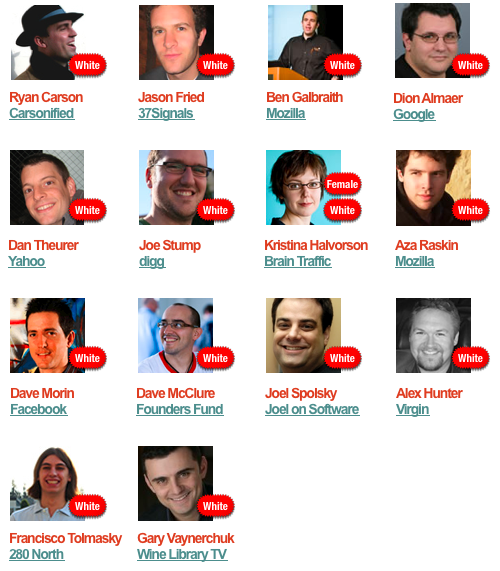
As a white boy who attended yesterday and today’s Future of Web Apps summit, I feel compelled to speak up about a disturbing element of an otherwise well-produced event.
In fact, when I got this fortune the other night, it made me realize how important it was to speak out:

Clearly the issue that I’m presenting is a familiar one — one of the perennials that comes around with the regularity of seasons. In the relatively short time that I’ve lived out in San Francisco and become immersed in the Valley culture, I can recall this topic presenting itself at least once a quarter. At least.
And the reason is simple: the issue of diversity in culture is intractable and unsolvable. It needs constant work and attention; it’s a matter of mindfulness and inclusivity, because regardless of how diverse you become (or think you are), you can always do better. No, really.
We can and must choose to make diversity a top priority, one that’s up there with attracting quality talent and quality attendees; it will not simply happen on its own and truly, it’s everyone’s responsibility.
But it’s not that simple, as much as I wish it were.
I talked to Ryan Carson and Lisa about this — about why there was so little diversity (especially gender diversity) at FoWA. Apparently they did try to recruit some women speakers, but the two that came to mind didn’t respond in time; so the Carson crew got tied up organizing everything else and the matter fell by the wayside. Once they had their final speaker line up, it was too late.
Perhaps if the issue had been raised far enough in advance, something could have been done (take for example the upcoming 45:2 AJAX Experience conference — all but 3 are white — apparently their trademark “No Fluff, Just Stuff” refers to minorities). This is what Elisa Camahort of BlogHer, says:
The solution is for event organizers to care about diversity in their own planning stage, not after they’ve already spent the time securing and then announcing dozens and dozens of speakers.
Totally.
And so then I talked to Matt yesterday and he pointed out that, well, maybe, the speakers represent the make-up of the community.
Which of course is a logical argument to make. And a complete cop out (sorry Matt).
There’s something important here that needs to be impressed upon us white boys by a white boy — one who happens to find himself uncomfortably in the white boy club (just coz you’re born into it doesn’t mean that you’re not responsible for being part of the change that needs to happen). It goes back to that fortune I got and to the point I made at 20×2 at SXSW last year: as it stands, we, as white men (of course I include myself in that), have a tremendous amount of privilege and power — power that many of us don’t know we have, power that many of us choose to ignore, power that some of us disclaim or shrug off. The utter reality is that whether you want it or not, you have the power and the potential to be part of the ongoing solution.
Now let me suggest an elevation of the topic, because there’s really something practical and motivating about this power that we have. First of all, it’s not something shameful and it’s not something that we ought feel bad about; admitting and owning our historically exclusionary behavior will not emasculate us. On the contrary, to my thinking, taking responsibility and doing something shows a degree of chivalry that can reveal where true insecurity lies.
But it’s not about chivalry. Because the act of diversifying should be done because of merit, not in spite of it. In fact, there are three concrete benefits to be gained from proactive inclusivity:
- For one thing, FoWA would have been more representative, more interesting and more engaging (and better attended) had their been wider diversity. If Drupal is any indication, monocultures produce monotonous culture (think Art with a big A). And the very last thing that I, personally, want to see in the real future of web apps is a lack of diversity.The greater the diversity in the folks who are participating, creating and discussing the future of web apps will bring result in more diverse ideas, approaches, beliefs and experiences to be built into the tools of tomorrow, leading to an environment a whole lot more exciting than the alternative.
- Instead of having to duck for cover whenever you’re exposed as a hapless ignorant fool, there’s a whole lot less guilt and worry in doing the right thing (imagine that!). You can actually feel proud of yourself for making diversity a priority (which will improve your event anyway — and likely increase the demographics of those interested in attending).So wow, doing the right thing feels good and is economically beneficial?! No way!
- Lastly, by giving away and spreading out our power, it actually improves our position in culture while increases the visibility of our peers. I’ve long believed that in a networked world, by giving everything away, you gain more. It’s kind of the principle upon which P2P networks work.So this power that we white men have? It’s only power if we actually give it away and spread out our privilege as much as possible. In whatever form it might take, this potential power means nothing unless we actually use it — so by working to fix the problem, we’re actually proving what kind of man we are.
So let me be bold: the future of the white boy club is in inclusivity one-upmanship. Not just because it benefits everybody, but because it benefits us. We simply can’t stay hidden in our isolated little geek enclaves and plead ignorance or expect things to get better by themselves; there’s too much at stake, too much to gain and too many interesting voices out in that great bazaar that we’re missing out on that we must do more to encourage, support and welcome them where in the past we have failed.
It won’t be easy, but dammit, nothing worthwhile ever is.
And, as a first step, I’ve set up the BarCamp Diversity page to collect ideas, thoughts, examples and techniques to improve BarCamp — because, frankly, we must be most critical of those things closest to us that we have proven power to change.
Exposing microformats

After getting a new tool for composing microformats, we now have a new technique for exposing those newly minted microformatted hcards.
Jon Hicks has created expose-mf.css as a browser CSS add-on that will reveal hcards inline, as opposed to external to the page, like Tails.
While there are some obvious bugs, this technique demonstrates how revealing embedding microformats in webpages can become a great tool for data discovery and manipulation.
Outfoxed tries going Lijit
Browser-based trust aggregator Outfoxed has been rebranded as Lijit and launched a new beta site (built on Drupal — which seems to be having some issues… ah well).
Lijit essentially allows you to connect with friends and based on how much you trust them, use them or their connections to filter search results or “advise you” on the legitimacy of any arbitrary website. You can sign up for the beta on the homepage.
iTunes 7 breaks VolumeLogic
According to their website, audio enhancement plugin VolumeLogic no longer works in iTunes 7. I swear by this plugin and am totally bummed that it doesn’t work anymore; recommended steps are to hold off upgrading to iTunes 7 (too late me!) or to wait it out. <<sniff>>
Heads: microformats creator for Flock

Well, it took the community to do it first, but geoFlock creator Tony Farndon’s done gone and created a Microformats creator for Flock called… Heads!
And, owing the it’s design, can easily accomodate many other formats without too much effort… excellent.
 Factory Joe