If you don’t have plans already, check out the Songbird party this Friday at the Songbird Nest as they near their 0.2 release (plans for 0.3 are already underway!).
Category: I care about…
A solution for Google Calendar on Blackberry 8700c
Gah, finally!
I meant to write about this ages ago, but now that Version 1.1 is out thanks to Thomas Oldervoll, I can happily report that I have Google Calendar working on my Blackberry 8700c!
For awhile I was using 30Boxes Mobile as my Gcal proxy, but no longer! I can unhide that Calendar app on my Blackberry desktop now that I’ve got the open-source Gcalsync running!
Cut-to-the-chase instructions: load up wap.gcalsync.com on your Blackberry and install the signed version. Run the app. Choose Sync, type in your Google username and password (no idea how trustworthy this thing is) and hit Save. The Sync should commence.
Now, I had some issues with this, but it’s better than nothing, so I can only hope that Thomas will continue his work (or you’ll pitch in).
And hey, if it works for you, digg it.
The origins of DevHouse

Following SHDH12, Jeff offers the origin story of teh DevHouse:
Let me tell you how I saw DevHouse get started.
He goes on to describe his hope for future events:
My vision, if any, is to have a whole ecology of specialized and general purpose DevHouse events that are self-organizing and take place wherever there are hackers. : )
So, we’ll see. I’m going to make an effort to make this happen when I can. I want to first try to work with CocoaDevHouse better, and figure out what kind of relationship works. I also want to try starting another specialized event for indie game development. And we’ve been talking and working a bit to make some software to help with the network infrastructure of these kinds of events. I’ve been talking with some people about writing some software to help complement the wiki-based way of promoting and organizing these events.
Nice.
So don’t miss SHDH13, coming up Nov 4-5 in Los Gatos.
Soundflavor launches — a new way to discover the music you already own

Peter Merholz has blogged the release of Soundflavor, the first product released from Adaptive Path’s New Ventures project.
Lane’s written up a case study describing the process that was used to develop the app, notably using an iterative, design-and-build process, as opposed to using a documentation-design-implement method (kind of like the waterfall method).
Of course, I know quite a bit about this process, since this was also the first product that I helped design after leaving Flock (I, too, can claim that i made this, along with Dan Saffer and others, including Tim from Big Empty and the great folks at Soundflavor). In fact, I helped out with the initial spec, product development and design process and facilitating the brainstorming that lead to the soon-to-revealed relationship between the app and the website. Unfortunately, early into the development cycle, travel and other commitments precluded me from seeing out the implementation of the product, even though the final result is very much in line with my original concepts.
So what’s so great about Soundflavor?
Well, unlike other streaming services like Pandora (of which I’m a huge fan), it actually pulls music from your existing music collection and music shared on your local network with Bonjour, creating interactive playlists that vary in “flavor”, or similarity, helping you to rediscover the music that you already own or that the people around you own.
Of course, in addition to that, Soundflavor will recommend new music similar to what you already own or are listening to for purchasing and building out your library.
And, with the Playlist Creator, you can take Soundflavor’s work with you — simply pick a track, artist or album as a “flavor” and Soundflavor will generate a playlist with as many “flavored” tracks as you want (more feature details can be found on the download page).
Reviews so far seem good, and I’m eager to see their playlist-cum-mixtape sharing community launch (think deviantART meets iMix) — and hopefully, someday, Lucas Gonze will have his way (I rallied for ya, man!).
Anyway, I’m dying for the Mac version to come out — as the subset of tracks I listen to from my 22,000 track library is starting to go stale (as evidenced by my Last.fm account). Give it a shot and let me know what you think — since I can’t try it yet and would like to know, in terms of iTunes controllers, how this one stacks up given its pretty sweet featureset.
Starfish and censorship
 I’ve started reading Ori Brafman’s excellent The Spider and the Starfish and came across an article in the New York Times relating the use of services like Googlebait YouTube to post uncensored video from conflicts around the world, primarily from Afghanistan and Iraq.
There are a few key quotes that I think are telling, and sets up rather well the contrast that Ori illuminates in his book. On the side of the decentralized starfish:
Russell K. Terry, a Vietnam veteran who founded the Iraq War Veterans Organization, said he had mixed feelings about the videos.
“It’s unfortunate there’s no way to stop it,” Mr. Terry said, even though “this is what these guys are over there fighting for: freedom of speech.”
Emphasis mine.
On the opposing side, illustrating what Brafman describes as the second principle of decentralization: “it’s easy to mistake starfish for spiders”:
Geoffrey D. W. Wawro, director of the Center for the Study of Military History at the University of North Texas and a former instructor at the United States Naval War College, said the erosion of the command structure of terrorist and insurgent groups had led them to increase their reliance on the Internet and videos to gain recruits.
Emphasis, again, mine.
That a military person would suggest that terrorist and insurgent groups actually ever had a centralized, or coercive, chain of command smacks at being ludicrous, given recent experience. You’ll note, for example, that even with terrorist “leader” Al Zarqawi snubbed out, the terrorist threat is as potent as ever. Taking him out wasn’t taking out the head of the spider, as Wawro would probably argue; rather, according to Brafman, we succeeded only in chopping off a leg of the starfish:
Cut off a spider’s leg, and you’ll have a seven-legged cripple. Cut off its head, and you’ll kill the spider. But cut off the starfish’s arm, and not only will it regenerate, but the severed arm will actually grow an entirely new body. Starfish can achieve this remarkable feat because, unlike spiders, they lack central control—their organs are replicated across each arm. Starfish are decentralized.
Just like in nature, there are also starfish on the battlefield. Starfish forces don’t have a leader, clear structure, or defined hierarchy. These seemingly chaotic qualities make Starfish unexpectedly resilient.
So, for one thing, censorship, on the part of YouTube and/or Google is a losing battle (no pun intended) and one that makes matter worse, since it keeps the US citizenry ill-informed and naive to what’s really going on overseas. It strikes me that not all “graphic violence”, is created equally, as Julie Supan, senior director of marketing for YouTube, seems to think:
In an e-mail message, Ms. Supan said that among the videos removed were those that “display graphic depictions of violence in addition to any war footage (U.S. or other) displayed with intent to shock or disgust, or graphic war footage with implied death (of U.S. troops or otherwise).”
Perhaps the argument is that graphic violence masquerading as entertainment should be censored — well, in private media collections, okay, sure; but, when the same kind of information is also more informative than what our media is allowed to show, does it take on a purpose that should invoke the protections of journalism?
Hard to say, but the lesson Ori offers to the military is one that YouTube and others should also heed: Our military is discovering what happens when a spider takes on a starfish.
A Single Flower on October 20
Richard Giles pointed me to A Single Flower, a campaign started in Australia launched this week with a simple, straight-forward purpose: “…on this day, you display a single flower to show the world that you are concerned about the needless death and violence that is taking place around us.”
Former Flocker joins Automattic
 Lloyd’s finally announced his new role with WordPress-shop Automattic after leaving Flock:
Today is my first day of every day being an Automattic day!
I am Automattic’s Entomology Assistant — their QA person: bug finder and describer, bug gardner, quality advisor, and QA community collaborator.
I am passionate and knowledge about many aspects of software development and support.
I have enjoyed getting familiar with WordPress since first starting with Flock (one of WordPress.com’s first partner) over a year ago, spending more time these last many months, and accelerating my experience these last few weeks. I know I have a special opportunity because I am one of Automattic’s few hires from outside of the core WordPress community.
I have never been so excited to work with each and every member of a team. I am enjoying learning from everyone!
Another fool leaves the Flock
 The title of this post might sound meaner than it really is, but I’m referring to the departure of Lloyd “Foolswisdom” Budd from Flock.
This is something I’ve known about for awhile (as well as Bart’s departure before it was made public), but Lloyd’s post does a pretty good job capturing what clearly was a tough decision with hundreds of photos from his stay at what some might call the yellow canary of Web 2.0.
Things for good for Lloyd and his new bride, however, and I’m excited to find out what’s next for them as they resettle in Victoria, BC.
And yeah, I presume that he’ll keep up with his masterful photography work and foodporn shots.
In the trenches against the RIAA
 Denise Howell pointed to a Slashdot interview with two lawyers from Vandenberg & Feliu, LLP in New York who are in the precarious position of both defending against claims wrought by the RIAA and blogging about it. It seems that their play by play is now in danger of being outlawed. Seriously. WTF. They’re hitting us on all sides.
The Future of White Boy clubs
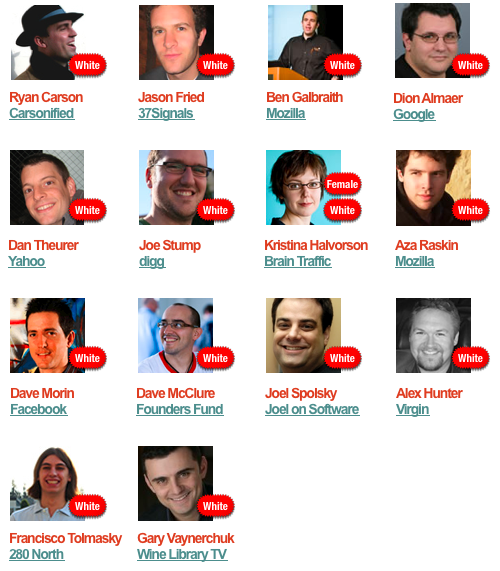
As a white boy who attended yesterday and today’s Future of Web Apps summit, I feel compelled to speak up about a disturbing element of an otherwise well-produced event.
In fact, when I got this fortune the other night, it made me realize how important it was to speak out:

Clearly the issue that I’m presenting is a familiar one — one of the perennials that comes around with the regularity of seasons. In the relatively short time that I’ve lived out in San Francisco and become immersed in the Valley culture, I can recall this topic presenting itself at least once a quarter. At least.
And the reason is simple: the issue of diversity in culture is intractable and unsolvable. It needs constant work and attention; it’s a matter of mindfulness and inclusivity, because regardless of how diverse you become (or think you are), you can always do better. No, really.
We can and must choose to make diversity a top priority, one that’s up there with attracting quality talent and quality attendees; it will not simply happen on its own and truly, it’s everyone’s responsibility.
But it’s not that simple, as much as I wish it were.
I talked to Ryan Carson and Lisa about this — about why there was so little diversity (especially gender diversity) at FoWA. Apparently they did try to recruit some women speakers, but the two that came to mind didn’t respond in time; so the Carson crew got tied up organizing everything else and the matter fell by the wayside. Once they had their final speaker line up, it was too late.
Perhaps if the issue had been raised far enough in advance, something could have been done (take for example the upcoming 45:2 AJAX Experience conference — all but 3 are white — apparently their trademark “No Fluff, Just Stuff” refers to minorities). This is what Elisa Camahort of BlogHer, says:
The solution is for event organizers to care about diversity in their own planning stage, not after they’ve already spent the time securing and then announcing dozens and dozens of speakers.
Totally.
And so then I talked to Matt yesterday and he pointed out that, well, maybe, the speakers represent the make-up of the community.
Which of course is a logical argument to make. And a complete cop out (sorry Matt).
There’s something important here that needs to be impressed upon us white boys by a white boy — one who happens to find himself uncomfortably in the white boy club (just coz you’re born into it doesn’t mean that you’re not responsible for being part of the change that needs to happen). It goes back to that fortune I got and to the point I made at 20×2 at SXSW last year: as it stands, we, as white men (of course I include myself in that), have a tremendous amount of privilege and power — power that many of us don’t know we have, power that many of us choose to ignore, power that some of us disclaim or shrug off. The utter reality is that whether you want it or not, you have the power and the potential to be part of the ongoing solution.
Now let me suggest an elevation of the topic, because there’s really something practical and motivating about this power that we have. First of all, it’s not something shameful and it’s not something that we ought feel bad about; admitting and owning our historically exclusionary behavior will not emasculate us. On the contrary, to my thinking, taking responsibility and doing something shows a degree of chivalry that can reveal where true insecurity lies.
But it’s not about chivalry. Because the act of diversifying should be done because of merit, not in spite of it. In fact, there are three concrete benefits to be gained from proactive inclusivity:
- For one thing, FoWA would have been more representative, more interesting and more engaging (and better attended) had their been wider diversity. If Drupal is any indication, monocultures produce monotonous culture (think Art with a big A). And the very last thing that I, personally, want to see in the real future of web apps is a lack of diversity.The greater the diversity in the folks who are participating, creating and discussing the future of web apps will bring result in more diverse ideas, approaches, beliefs and experiences to be built into the tools of tomorrow, leading to an environment a whole lot more exciting than the alternative.
- Instead of having to duck for cover whenever you’re exposed as a hapless ignorant fool, there’s a whole lot less guilt and worry in doing the right thing (imagine that!). You can actually feel proud of yourself for making diversity a priority (which will improve your event anyway — and likely increase the demographics of those interested in attending).So wow, doing the right thing feels good and is economically beneficial?! No way!
- Lastly, by giving away and spreading out our power, it actually improves our position in culture while increases the visibility of our peers. I’ve long believed that in a networked world, by giving everything away, you gain more. It’s kind of the principle upon which P2P networks work.So this power that we white men have? It’s only power if we actually give it away and spread out our privilege as much as possible. In whatever form it might take, this potential power means nothing unless we actually use it — so by working to fix the problem, we’re actually proving what kind of man we are.
So let me be bold: the future of the white boy club is in inclusivity one-upmanship. Not just because it benefits everybody, but because it benefits us. We simply can’t stay hidden in our isolated little geek enclaves and plead ignorance or expect things to get better by themselves; there’s too much at stake, too much to gain and too many interesting voices out in that great bazaar that we’re missing out on that we must do more to encourage, support and welcome them where in the past we have failed.
It won’t be easy, but dammit, nothing worthwhile ever is.
And, as a first step, I’ve set up the BarCamp Diversity page to collect ideas, thoughts, examples and techniques to improve BarCamp — because, frankly, we must be most critical of those things closest to us that we have proven power to change.
 Factory Joe
