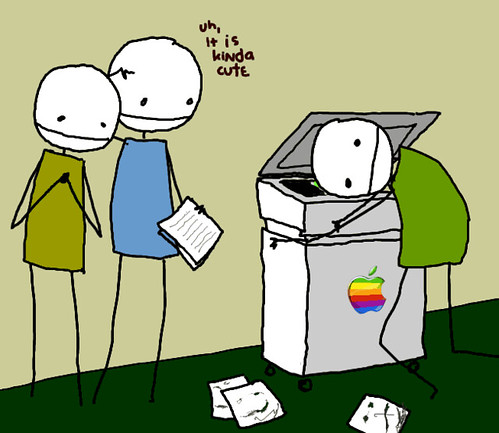
This whole crowd-sourcing thing is pretty interesting, especially when you’re as big as Apple and you have as dedicated a following as it does. And when your caché is innovation and constant coolification, you’ve always gotta deliver something wicked to knock ’em dead.
But, one supposes, those ideas need not come from within, and, when you’re Apple (or Google or whomever), looking to your community for ideas is probably as sure a bet as any for coming up with something you’d not thunk up (or at least not yet ripped off).
And so while Jobs gave his keynote at WWDC yesterday pointing out Redmond’s failure to deliver on Vista while OSX continues to steam ahead, I found it interesting that many of the features that they’re selling this upgrade with can already be found in the Mac developer community.
Take for example:
- Dashboard & Dashcode: Amnesty Singles ($9.95) and WCode ($15) and Wishingline’s Dashboard Widget Xcode Template
- Spaces: Virtue Desktops (open source), Desktop Manager (open source), You Control: Desktops ($29.95)
- Time Machine: SuperDuper! ($27.95), Lifeboat ($30), iBackup (donation-ware) or Carbon Copy Cloner (donation-ware)
- CoreAnimation: Coverflow (free), SVG or Flash (ok, not really an accurate comparison)
- Mail: (…almost too many to list) Mail2iCalToDo (free), Mail2iCal (free), Note To Self, Mail to ToDo X (free), MailTemplate ($14.95),
- iChat: Tiffany Screens (free), XMeeting videoconferencing (open source), Adium (open source)
- Spotlight: HoudahSpot ($14.95) and Meta — complex queries; Searchlight — Spotlight for networks ($29.90); Quicksilver (free), Launchbar ($19.95 – $29.95) and Butler (donation-ware) — for application launching
- iCal: Gcal (open source) + Google Calendar (free)
Now, don’t get me wrong. Building these features into the OS means that lots more people will get the benefit of these tools that many of us early adopters have already discovered. And, given Apple’s engineering and design pedigree, oftentimes that means that the Apple versions will be more stable, in some cases more useful and almost certainly more pretty (though not always).
But, it also means that a bunch of independent software developers who rely on selling these small but potent tools that Apple has now co-opted will lose business, not to mention get no return on the hard work, money and time spent building these tools. All Apple has to do is summarily drop a few of these features into a major dot-release, crank up the hype machine, and poof, more developers out of work. As Marc put it, what kind of ecosystem is that?
Unlike the open source community, where developer’s names are attached to the patches and contributions that they make to a project, Apple offers no such credit, and, in turn, takes all the glory.
And, if you read me much, you know that I’m a big proponent of open source, of open standards, and open formats; I also tend to see patents and trademarks as belonging to the litigious and anti-cooperative capitalist elite who can afford such protections, forcing the small business innovator to choose between either doing what she loves or taking the steps to protect it — as the cost, time and passion pursuing either makes both rather mutually exclusive.
And so it is yet another manifestation of the digital divide — of those who have the money and the legal departments to protect their innovations — or sue or pay off those who innovate for them — against those who live from registration to registration, making an independent and meaningful, yet staccatic economic, existence.


 Factory Joe