Build me a distributed LazyWeb!

Microformats LogoSo I’m San Fransocializing with Tantek and Greg Elin, shootin’ the breeze and considering how we can push microformats into new domains and I got this idea for a distributed LazyWeb (I had no idea Hammersley wrote the original… Ben! You lazy bastard!).

If you’re not familiar with LazyWeb, it’s like this: Need something done? Just blog it and trackback to LazyWeb.org’s trackback address. Pretty simple right? In fact, that’s how I’m planning on having extension reviews work on the redesigned Flock site. But that’s down the road.

Anyway, as I was explaining…

I want to publish tasks on my blog and have them get aggregated along with a bunch of other people’s… but it would be crazy useful if you could group like tasks and aggregate them to see other people with the same needs. Who knows, maybe when you find 15 people wanting the same thing, you can start a Fundable project or something. You figure it out.

The geektastic idea I had was this (since, you’ll recall, the topic of conversation was microformats): use the vtodo component of hCalendar to represent your LazyWeb task. You could use the organizer, summary, attendee, categories and even status and priority classes to represent the aspects of the task. The value of the organizer would be a link to your blog using rel=”me” from XFN. If someone accepts the task, you can add an XFN relationship to the attendee link.

And then, through the magic of the intarweb, a spider could be used to seek out these tasks and index by tags in the categories. Subscribe a certain task-tag and voila! — your weekends will never be unproductive again! …and, I’ve got my distributed LazyWeb!

technorati tags: , , , ,

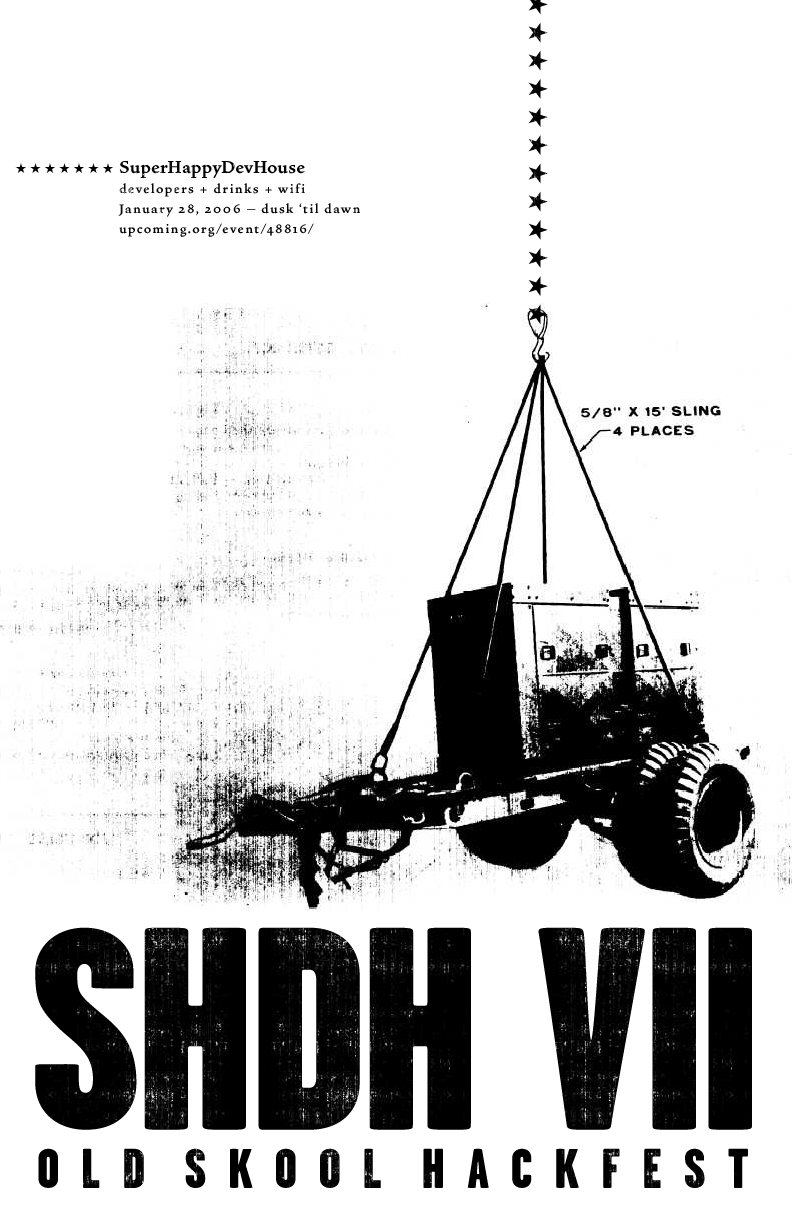
SHDH VII: Old Skool Hackfest

January 28

, get ready to rock it old sk00l with SHDH. No presentations this time (that doesn’t mean they’re gone for good, we just wanted to get our hack on full steam). So bring your laptop and a beer and get ready to make something great. Bonus points for coming up with really cool stuff in the middle of the night. 🙂

– David Weekly, Jeff Lindsay & The SHDH Team

SHDH 7: Old Skool Rocking | superhappydevhouse

Bar Camp at SXSW!

Bar Camp Austin

Holy crap. Bar Camp @ SXSW.  I’ve yet to do my Bar Camp NYC recap and already it’s spreading again…

Looks like Bar Camp London brainstorming is picking up too. Holy crap.

Now to just fix up the wiki and make it spamproof. I can’t even remember who’s hosting it now. Dammit, why does technology have to be so frustrating? 

technorati tags: , , ,

send_pings and losing my innocense

Sleight of handI’m writing this post with some real hesitance, feeling like I’ve just stepped into a cigar-smoke filled backroom with the bunch of thugs who really run this town… and they’re pulling out their tommy guns to take me out as I’m frantically trying to write this.

Heh. 

Yeah, I tend to get a bit melodramatic when I write, but this time I really feel like I’m tossing it on the line… I mean, this is my job I’m talking about here and though I’ve feigned to be so direct before, this issue cuts at the heart of the work that I’m doing. And fuck if I feel like a piece of me is dying as a result of this.

Darin posted yesterday about a new ping attribute being added to link anchors in the trunk builds in Firefox. Basically links that used to look like this:

<a href="http://flock.com">Flock</a>

can now be written like this:

<a href="http://flock.com" ping="http://myeviltracker.com?source=factoryjoe.com/blog">Flock</a>

The result? Well, hover over the link and you’ll get a handy little status bar message telling you that Firefox is about to open (in this case) flock.com as it silently pings myeviltracker.com in the background. The benefit to you? Well, supposedly because you’re no longer visiting the redirection sites prior to hitting your final destination, pages will be perceived as loading faster. Whoopee.

At least, that’s the idea as spec’d by the WhatWG. Including it’s inherent evilness (see #4).

So why does this matter so much to me? Well, because I’m working on building a browser based on Firefox. Decisions made upstream obviously effect this work since the Mozilla technologies that power Firefox make up the core of Flock. And the decision to enable browser.send_pings by default trickles down to us. We inherit that decision and all the baggage and rationales that come with it. Including the impact on privacy.

I’m not so naive that I don’t recognize that all of our behavior is being tracked, analyzed and quanitified already, both online and off. (Hey, I saw the Matrix too!) But right now, as Hixie pointed out, it’s being done by advertisers via a series of obfuscated redirection URLs. Ever use a service like eBates? Notice the 5 or 10 servers that you’re bounced across before you land at the final page? This ping attribute is designed specifically to address that "problem"… to make landing on your final destination… smoother, faster.. more calming… wha? huh?

Sorry, I dozed off.

So while all the greedy hands in an online transaction will presumably be daylighted in the status bar (yeah, like they’ll all fit), it’s how this feature is being pushed through that scares the bejeebies out of me the most.

And dammit, I feel like more of my online childhood is being robbed from me. 

Think about it. Why is this feature being introduced? Who does it really help? Who does it really stand to benefit the most? Lemme give you a hint: it’s not you and it’s not me (despite what the proponents might say). Let me quote:

This change is being considered in large part because some very popular websites have asked for a solution to this problem.

Gee, can’t imagine which "very popular websites" those would be. Scoble, are you asking for features in competitor browsers again? C’mon man, we talked about that!

Oh wait, not that kind of popular… that kind of popular! As in… "all knowing, all seeing, all controlling"?

Oh oh, I get it; yes, exactly: to make tracking your behavior easier for advertisers.   

And here I thought the next name for Firefox would surely be Volksfoxen.

If the features of the next generation of browsers (Firefox 2 Alpha is just around the corner etc etc) are being driven by advertising, TBL help us.

I mean, sure, we’re trying to ask some serious questions about what the next 10 years of browsers look like too and we’re also funded by dudes with stogies in dimly-lit rooms (oh what, I’m not supposed to say that?), but, as far as I’m aware (remember, I’m young, dumb and naive), I haven’t been asking what the advertising industry has on its wishlist when I design features. Nor the et al. Nor enterprise. And no, that hasn’t happened with Firefox just yet, but I’m just concerned that if we’re not vigilant, it might. (Hey,shuddup, it might!)

I mean, the future of the web that I’m interested in investing in doesn’t treat people as statistics to be quantified. No, instead it’s more about what they have to say, what their contributions to this massive jerky conversation pool might look like, what bit of brilliance they might shine on the web that will change my life forever. It’s happened a couple times already and it didn’t result from monetizing the web better.

This send_pings feature reeks of special interests. So hey yeah, just because we’re downstream doesn’t mean we’ve gotta accept everything that trickles down. Insomuch as I’ve yet to be convinced that this feature doesn’t do anything to humanize the web or improve web standards, or help people communicate better, I’m moving to keep it from landing as default "on" in Flock. Call me a luddite, fine, but bug logged. Consequences, well… be damned.

Mash Pit underway; dinner and drinks planned!

Mash PItTotally last minute, but if you’re interested in the people and the results at the first evar Mash Pit, come tonight:

Lets Gets… Mashed! (Mash Pit Aftermeetup)

Zagora, 1007 Guerrero Street, San Francisco, California 94110
Tuesday, January 17, 2006(7:05 PM)

We’re well underway, hacking on project in localization, event creation (think, Bar Camp in a box!) and egotracking. Backchannel: irc.freenode.net/#mashpit.

Wanting a permanent coworking space

So I got a report from Niall last night that Ritro, my favorite cafe in town, has cut off power on the weekends… like, to the degree that they’re covering the outlets with labels reading “No Power”. Yikes!

This comes a few weeks after they blocked a bunch of ports useful for things like IRC, IM, Bonjour networking and SSH (etc).

Obviously they need to protect their business and it’s true that more often than not, more and more even casual vagabond hackers are spending time in cafes without buying a damn thing, not surprisingly pissing off the proprietors.

So while I’m totally sympathic with Eileen et al at Ritro (she needs to make money to keep her business around, after all, right?), this issue, in my view, further underscores the need for a more permanent coworking venue in San Francisco… one that feels like a cafe (and probably has coffee and tea and whatnot on hand) but encourages the productivity of a collaborative workspace.

It dawned on me that our ailing library system could actually be used for this purpose, except they seem to have this hang up with silence. If they got over that, I could see that being a resource, at least temporarily, for this idea.

Additionally, I’ve been talking with a bunch of folks about establishing a loft-like venue for this kind of environment… just imagine: free, stable wifi, juicy power, tasty coffee, desks, projectors… and lots of smart people doing hella cool stuff, having Mash Pits every other day. How would we afford this? Well, we could do what Brad’s already doing: charge a weekly/monthly/daily subscription fee for the use of a desk. No company would ever be able to have more than a certain percentage of desks bought out at any given time in the interest of diversity and inclusivity… and of course we’d keep it open to independent consultants and other interested folks just wanting to chill out for the day.

And what the heck, we’d have a backchannel going, some Bonjour networking… and of course an open SVN repository to dump all the good stuff that happens to emerge that wants to be open source.

So I don’t know when or even if this will happen, but it’s on my agenda for this year: an accessible, permanent space in San Francisco for geek innovation, neue thinking, GSD and making the kind of connections that can only happen in the real. Any takers?

…Miles of semantic markup before microformats

So I’m in need of a standard way of linking from a person’s profile to their external photos, blogs, vlogs, things and so on. Especially since I intend to use as the foundation for usual information (name, email, homepage, etc), rel=me (from ) and for marking up the list of links.

Now, I went into the Microformats IRC channel to ask for some guidance (the source of this post’s title, via teh Ryanz0r) and got shot down big time. Well, not like that was surprising since I know most of the guys in there personally and they don’t take me all that seriously, but still…!

Anyway, in discussing my use case and proposing some new values for “rel=” (like, ‘photos’, ‘videos’, ‘tasklist’, etc), Ryan made an interesting point about the development of microformats that I think a lot of folks would do well to consider: the achievement of becoming a microformat isn’t an end-all, be-all that one need aspire to. Rather, standardizing and codifying existing behavior requires anthropological attention and patience to what emerges over time.

Interestingly, this is how law develops and how standards that survive and are adopted are developed (I would wager this is true most of the time — consider mp3). I’ve even proposed a solution to a problem I’ve seen repeating itself with my Community Marks idea — the hope in this case is that enough communities will run into this problem that the idea will take off, over time.

So this post is about the microformats process and how it actually works. Just because we’ve knocked off a good dozen in its first year doesn’t mean the next dozen are going to come right away or be obvious. The point is not to guess at a microformat and try to win, instead, just start doing something if nothing that fits what you need exists. Over time, a standard will emerge that can be codified into a microformat.

In my case, I’ll probably use rel="me photos" to link to someone’s Flickr stream, rel="me tasks" for someone’s tasks and rel="me favorites" for favorites. If it gets picked up, awesome. If not, I’ve got a solution that I can use for now until some standard behavior emerges.

And that seems quintessentially inline with the microformats process.

Podcast from Bar Camp NYC

Greg Heller interviewing Chris Messina

Greg Heller interviewed me Sunday morning at the tremendously successful Bar Camp NYC. There wasn’t a whole lot of wine involved this time but I nevertheless ramble on about taking over the world or other dumb stuff. Fortunately Greg did a great job of being provocative and keeping me on my toes! The sound is a little rough, but hey, Greg shoots from the hip and encodes at a low bit rate.

Take a listen and lemme know what you think.

The Case for Community Marks

Executive summary: In recommending the establishment of Community Marks, I propose that an alternative to trademarks is needed for community-based projects like Bar Camp and Microformats. The need for Community Marks stems from the non-commercial focus of these projects and the way these projects spread virally on the web. While we need to protect the integrity of a brand like Bar Camp, licensing and legal enforcement is too costly in terms of time and money to make sense for loosely joined communities. Therefore, if we can leave enforcement up to the community via the Community Marks denotation, we will be able to serve the vital function of identifying a community’s work and projects without burdening that community with undue legal process and enforcement costs.

Community Mark You can’t imagine how excited I am to write this post… not only is it an important one, but I’ve just gotten my busted laptop back and wow (is this bad?) I feel like I have my life back again. Never really thought I’d say such a thing, but eet’s true I teenk.

So I’ve been discussing the idea of Community Marks with a wide number of folks for some time (starting back when I was working on Spread Firefox and preemptively released the hi-res versions of the Firefox logo before I had full authority (that post has since been taken down)). I believe that this idea is an important tool which has grown out of the emergent philosophy that I see in the camps and in community-directed, “unowned” projects like Microformats.

Let’s get into it: I’m not a lawyer and I will never pretend to be, but that doesn’t really matter as far as I’m concerned and I’ll tell you why.

When it comes down to it, law is totally made up by humans. It’s just a system of conventions that codify certain beliefs about morality and righteousness within the context of a given civilization, society or group.

Laws weren’t and aren’t always penned in Congress, either. In fact, unbeknownst to most school children, that timeless classic that tells of the “life of a bill” is simply a story that you can choose to agree or disagree with. For the purpose of this discussion, I disagree with its fundamental premise that all laws (and rules governing trade and so on) must go through that process to become “real” or as enforceable as any other law.

Sure, this could be an academic or artistic inquiry on my part, whatev, that’s fine. Today, I’m interested in a little armchair-legislation, the kind that has no teeth or legal basis in our current legal system, but nevertheless solves an important need with which existing law currently doesn’t deal: the need for community owned and enforced marks (as in an open alternative to trademarks).

I won’t belabor where this all came from, but suffice it to say that the SpreadSpread campaigns (Spread Firefox, et al) have repeatedly encountered problems when commercially valuable trademarks need to be put in the hands of a community and the public domain is not an option.

The view heretofore has been that this is necessary, with dubious restrictions that protect the ability of the trademark owner to enforce their brand and indeed ensure the perceived quality that their logo, wordmark or servicemark represents.

In the case of Firefox or Flock, even though they are the result of countless hours of volunteer effort, you still need to be able to prevent some nefarious hacker in the remote expanses of cyberspace from releasing a spyware-laden version of either browser and calling it by the name of the official binary. Allowing such behavior could conceivably cause confusion in the mind of the consumer and potentially lead to an economic impact on the brand’s reputation. Therefore, it would be legitimate (and legal) for either Flock or Firefox to go after the offender and stop them from continuing such behavior. Just check out the on the lengths one can go to protect their IP in such a situation. Seriously.

And that’s why trademark was created: to make sure the people who own a brand can enforce their dominion over it to keep making money off it unfettered.

Um..

I mean.. uh… “to guarantee the integrity of a brand’s goods or services in order to prevent confusion in the marketplace.” (Stupid Freudian slips!)

So anyway, that’s all good and well, but it’s not enough. And it doesn’t address the issue I’m trying to resolve: the need for a mark that is owned, operated and enforced by a community that isn’t driven by purely economic interest. Instead, the motivation derives from the desire to uniformly represent their work product as the output of a specific community. Period.

So the case for community marks is primarily necessitated by projects like Bar Camp, which collectively is the product of scattered cadres of individuals the world over who take ownership of the brand on behalf of the larger community. None own the name or mark outright, instead they agree to hold an event based on Bar Camp, espousing its primary principles; in that way, they are extending the reach of the mark and therefore have earned a de facto license to use the Bar Camp logo and moniker. Now, should another separate event be created with primarily commercial gain in mind that uses the Bar Camp brand and co-opts the integrity of the name, it would be up to the community to go after and enforce the brand, either through blogging, boycotting or other subversive means. We simply don’t have the financial or temporal resources to go after such an offender, but we do have a small army whose response could be economically devastating to that effort.

I mean, let’s look at two precedents here: Creative Commons and Microformats.

With Creative Commons, you’ve got this idea that maybe not everything needs to be owned exclusively by default… Maybe you can allow for some distributed ownership of intellectual work in order to grease subsequent derivative creative expression. And maybe both the community and the original author will see benefits.

With Microformats, they’re leveraging community behavior to standardize the way we mark up our documents for the benefit of everyone. No one owns Microformats, though Tantek et al do a pretty good job shepherding the community. Nevertheless, the result of their work is something that the community takes pride in, identifies with, would be willing to expend individual effort to defend the integrity of.

And we learn two more things from them: to solve human problems as a primary objective and second to pave the paths of existing behavior. Don’t reinvent everything all the time. Just do what’s simple; just codify what’s already being done.

And gee, we’ve come full circle haven’t we?

Microformats are basically mini-laws for marking up your documents. Hell, go ahead and break them, do your own thing, there’s no punishment because the community doesn’t see punishment as being in line with its sense of justice. But joining up and following the rules, in this case, will actually bring you some benefits and not to mention, make your life (if you’re a user of the web, anyway) a little bit better.

So let’s codify this need to represent community works in a common mark. I want to be able to put a stamp on the work that I do within a community that identifies it to the world — that says: Me and a buncha folks made this and we’re proud of it. We did it not to make money but out of passion and love and because it’s in our nature to create without secondary purposes in mind.

And then let’s call it a Community Mark to make it clear what’s driving our purpose. It’s not tradeit’s the community, stupid! And from now on, if you want to create your own Community Mark, just slap a CM on your mark and hope for the best. Hell, we can’t enforce these things unless we hand them over to a broader community anyway — and since it’s really the community that owns the mark anyway, who better to look out for their wellbeing?