iDP you ask? Well, that’s the new acronym you need to familiarize yourself with… it stands for “iDentity Provider” and in the world of OpenID, is akin to a credit card provider like MasterCard or Visa — since they provide you with a card and a network that accepts their plastic. Of course, Technorati was already a consumer, allowing you to claim your blogs… and now you can use your Technorati profile URL to log in at other OpenID enabled sites, like Ma.gnolia.
Category: Web building
XING adds support for microformats
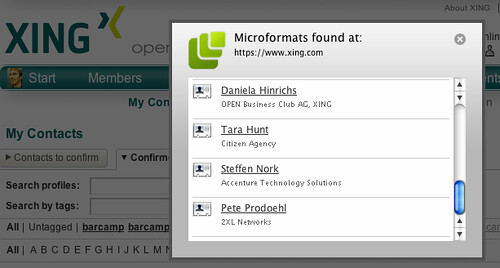
The popular-cum-controversial professional networking site formerly-known as OpenBC recently relaunched with a new name and design with wide support for hCard.
Tara first spoke with Daniela about implementing microformats ages ago and in follow up emails and blog posts, we encouraged and worked out various strategies (pro bono, mind you) around their microformats implementation. They’ve started basic with support for hCard and I hope that over time, they’ll add support for XFN, rel-tag, hCalendar and hResume.
Various extensions and web services can now detect private contacts in your XING account and add them to your address book or perform additional functions.
This work follows LinkedIn eventually adding support for hCard and hResume — work that, just maybe, we had something to do with as well. 😉
Hopefully XING’s support of microformats will make Sebastian happy for now, though it seems like he’s still a bit skeptical (though Google Translate didn’t help me much with his post).
Microformats in Drupal group formed
 In a very promising step, it looks like that venerable CMF Drupal is beginning to take on the process of becoming microformatted with the creation of the Microformats in Drupal group.
The original use of microformats came in the Upcoming.org module (I believe) but now it seems clear that there are many more places throughout Drupal that could benefit from microformats, including on the content creation side.
With word that OpenID support will be added to Drupal Core in version 6 (a module is already available for 4.7), if we see the addition of hcard for profiles and XFN for representing social relationships in Drupal, we may finally be moving towards a more decentralized, open-source network of socially adept web properties.
Skype + eBay + Google Local, Base and Payments, oh my!

Had a meeting with our advisor Don Thorson today (who’s currently at Jajah) and found it interesting to see that Google is strongly moving to make good on the deal they inked with eBay in August into the voice communications area.
First, they started talking about giving away ad-supported cell phones, then they added Skype to the Google Pack and now they’ve gone and made the most obvious play by adding click-to-call dialing to Google Local, executing on part of the original agreement.
With Skype adding SMS capabilities it’s curious to watch Google and Skype fight a pitched battle into telephony systems while the rest seem to be waiting and watching.
I mean, doesn’t this have an obvious end point?
I mean, take eBay listings, take Google Base, take Adwords as it spins out into radio and print, take Skype and take free click-to-calls where Google aka Skype foots the bill… add free cell phones… free wifi. And now give Google the tools to monetize the whole lot of the transactions flowing over its servers, airwaves and cell towers… and the ability to know who you are, what you’re up to, what you like, and how much you’re worth to advertisers.
If I were a farming man, I’d be a tad concerned about these Google silos cropping up along the horizon. But that’s just me.
Microformats + Flash: Who knew?

One aspect of microformats that’s not been widely discussed or perhaps even considered is their interaction with Flash apps like YourMinis… you might be guffawing there, but fer real — it’s not just shiny shiny!
 Ok, so check this out. Go grab the YourMinis extension (recently updated!) and install it in Firefox. Restart, as usual, and now, whenever you’re on a page with microformatted content, you can launch the extension to “suck out” the data and toss it into your app of choice…
It only gets better from here as YourMinis can be used to unify your experience across sites… So if you thought that semantic web is only good for HTML, well, guess again… especially with the Adobe-Mozilla deal in place, expect more very interesting developments in the microformats-slash-rich-interface department very soon.
Pieces of me: disintegrating online micro-presence

 …Just came upon Jaiku, the latest in micro-presence aggregation apps, thanks to ex-roommate Andy Smith, who’s now working with them — in one of his first gigs post Flock.
They recently went through a redesign and I have to admit, it looks pretty good.
It makes you wonder though, just because you can pull in the pieces of your multi-faceted identity into one place, should you? (With more variants of this idea popping up regularly, there’s clearly a trend here.)
I mean, in theory, horizontal integration may lead to a fuller picture of you, but the reality is that folks might only be interested in certain verticals of your life, and not the whole kaboodle.
And even when I was sketching out Rhyzomatic to solve my own problem of decentralized identity, my thinking was along the lines of bringing together links to the original sources, and letting people choose which pieces interest them most. Admittedly, I’ve merged in a few Flickr updates here and there with daily Ma.gnolia updates, but that’s as far as I’ve gone (even then I asked permission and some folks derided my choice — though I can’t find the post now).
So I’ve got Twitter, I’ve got Plazes, I’ve got my blog (more than one), Flickr, YouTube, and on and on. I should be better about maintaining it, but I’ve got ClaimID pointing to these and other sources as well. Along comes Jaiku and allows me to bring these things all together into one river, and well, I like it, but without the original context, how does it represent me? This may be a case where the sum is not greater than the parts — and that, for online identities to work, you have to allow people to break off the pieces of people that actually interest them most.
This is curious to me, and perhaps to other side of single sign-on and unified identity. Maybe you like my screenshots but find my blog boring. Should I force you to consume all of it just because I think it’s interesting? Somehow that flies contrary to the best aspects (pun intended) of this, the modern web.
Gang warfare, Web 2.0 style

Summary: Adobe + Mozilla + Google are ganging up to take down Microsoft to become the definitive future web platform.
I’ve been reading with great interest and intrigue about Adobe’s substantial contribution to Firefox’s codebase in the form of open sourcing Flash Player 9’s virtual machine.
On the one hand, I’m tempted to go and congratulate Adobe for their good will and desire to support “sustaining innovations“.
On the other, more cynical, hand, I know enough to read between the lines and see this for what it really is: business as usual, with the good grace of open source being used as a context for making this appear “nicer” than it really is.
But don’t get me wrong — this is a good thing for the web, for web denizens, for web developers, open source and for innovation. So that’s not what I’d like to point out here.
Instead, I’d like to offer a theory that this is a calculated move by at least Adobe (if not Mozilla and Google collectively) to go at Microsoft’s jugular just when it’s starting to regain its some of momentum as the dominant web platform after releasing IE7. (Note that my intimations are purely conjectural and not based on known fact. Whether intentional or not, this announcement spells out an alternative future, and it’s worth teasing out what it might look like, even as the story is developing.)
So let’s state some baseline assumptions and assertions:
- Adobe PDF is Adobe’s crown jewel. Their virtual monopoly on this rich format provides them a huge amount of business through their Acrobat product (now in version 8) — and they’ve moved to protect it before.
- Adobe Flash Players are installed in well over 90% of client browsers, making it the most widely deployed browser plugin anywhere (note the tie-in to Flash video — and who’s the biggest consumer here? YouTube much?)
- JavaScript and ActionScript (Flash’s programming language) are very close cousins — pushing EMCAScript and ActionScript closer through a faster virtual machine inches Flash ever-closer to subsuming the browser.
- Apollo offers to wed the best of Flash, Flex, HTML, Ajax and PDF — hell, you can even build a browser with this stuff
Contrary to Liz Gannes’ take, I think Adobe might, somehow, be positioning itself very wisely to help shape the future of online publishing, data interchange and rich web experiences. In fact, by nuzzling up to Mozilla and offering more and more open betas (though still with obnoxiously unruly EULAs), Adobe is starting to have the sheen of an open source player.
So let’s think about this: Microsoft is set to release Vista soon — and just as the delineation between web and desktop is finally evaporating — Adobe and Mozilla strike out with a bold partnership that firmly implants Adobe’s engineering technologies into the core equation between browser and desktop. And, given the large number of XHTML and Flash gurus in the wild, this seems like the death nell for XAML before the shrink wrap has even been removed. This isn’t about Flash becoming the web OS; this is about Adobe protecting and promoting it own delivery platforms and formats as it tag teams with Google to suck the “Live” out of Microsoft before it even has a chance to counter.
Adobe wants to be front and center in every browser; it’s smart enough to recognize however, that, like Google, the core threat to their position in the market is Microsoft’s Live platform technologies. An Adobe browser couldn’t dent Microsoft’s platform share, but two open source browsers can by creating the de facto web publishing environment and tools for the future of the web-centric desktop.
An interesting development indeed.
Introducing the GoogleBerry

Let everyone else build the frames and the platforms… it’ll be Google Content thru and thru.
In fact now you can grab all four of Google’s mobile services, including:
- Search
- Maps
- Gmail
- Google News
… in one fell swoop (load on your mobile device, direct download).
This bundle includes the Gmail client that Google recently released, though with a set of four alternative icons. The set will also notify you when new versions are available.
Admittedly, these are some very useful and pretty well-designed applications for BlackBerry mobile users. The question is — where’s the competition?
Last.fm adds support for hCalendar

Guillermo Esteves has notified me that another site has added microformats under the hood — and, just like Apple’s dotMac Webmail, for password-protected content.
They don’t mention it, but this means that you can easily add concert listings on Last.fm, complete with recommended gigs to your calendar without breaking a sweat (or a finger).
They let you add gigs, but what’s missing is the ability to point at an Upcoming, Eventful or Yahoo! Local URL and pull in the microformatted content to create a subscription to the existing event.
Ya dig?
Internet Explorer 8.0 will support microformats
 We now have confirmation that something that many of us in the community have suspected for some time (owing to Ray Ozzie’s Live Clipboard demo): that upcoming versions of Internet Explorer, expected some time in the next 12-18 months, will include support for microformats.
This, apparently, is straight from Chris Wilson, the new platform architect for IE:
“Mash-ups will continue to drive innovation. Componentization and semantic tagging of data will be supported,” Wilson told the Ajax Experience crowd. Wilson touted the harnessing of microformats, like Microsoft has done with its Live Clipboard effort, as “real world stuff” that will “make the Web much more usable.”
“Microformats add meaning to content in HTML,” Wilson said.
With discussions around support for microformats in Firefox 3, and Apple showing strong support for microformats as well, it’s only a very short amount of time before we can move on from the “so who’s using microformats?” question to “okay, so now what can we do with them?”
 Factory Joe