Writing history: Technorati adopts OpenID

Technorati adds support for OpenID

In an excellent sign of what’s surely to come, Technorati has adopted , at least for the moment, to claim your blog. This is a good first start and public display of support for this grassroots authentication protocol developer by Brad Fitzpatrick of LiveJournal, but until they fully support it to login to your actual Technorati account, this move serves only to whet the appetite.

But Technorati’s support does deserve recognition, as it is still early in the days of distributed single sign-on. Furthermore, the issues around remote login are many and require the involvement of and efforts from a wide range of diverse folks to help push through viable solutions for the myriad interface, user flow and communication challenges that this emerging standard brings with it.

As Ian Kallen of Technorati points out, there are still a number of issues to be resolved, chief among them:

I’m well aware of the concerns about phishy user interface vulnerabilities. The idea of logging in without a password may seem weird.

But that concern in and of itself should not prevent the continued building out of the OpenID network, especially as some smart folks are working on these, and other, thorny issues.

There are two things worth mentioning here as well.

First is that there was an agreement (perhaps a gentleperson’s agreement only) that stated that once Technorati added support for OpenID, LiveJournal would add support for microformats. Whether blog claiming constitutes “support for OpenID” as was intended by the offer is unclear, but it would be a rather positive development if LiveJournal did add support for , and other microformats.

Second, and more importantly, this example demonstrates the potential (I hate to say it) “longtail” value of support a decentralized authentication protocol like OpenID.

Consider this: let’s say that you blog on Blogger or on Yahoo! 360 or on MSN Spaces… as you probably know, each of the majors has their own authentication protocol (Google’s GAuth, Yahoo!’s BBAuth and Microsoft’s CardSpace, respectively). No doubt Technorati could add support claiming your blog using those protocols, no problem. But let’s say that you don’t want to play in one of those three de facto identity silos… what if you’re building your own independent blogging platform and want to offer authentication not provided by one of the Big Three? What are your options? What if you also want to use that same protocol to allow your users to have one login account across your other products?

Well, OpenID is designed to serve that purpose. In fact, you can run your own identity provider without needing to come close to the big three… and yet if did want to support them, work is being done (more thorny work I might add) to unify all your accounts into one OpenID that supports the big three. It’s highly unlikely, meanwhile, for the big three to do the same on their systems (for various appropriate reasons).

But here’s the thing: OpenID provides independents — individuals and small businesses — a way to play in the big leagues like the big guys without having to build the same kind of massive account infrastructure that they have. Furthermore, owing to the network effects of this standard, the more folks who consume and port around OpenIDs, the more valuable the network.

This is why we promote OpenID to all of our clients — as each one adds support for OpenID, all of our client’s clients (our real customers) can then log in and share their accounts across the services that our clients are building. This is a fundamental key to the non-zero sum economics that we preach! People like flexibility, they like control over their data and they like to be in charge of their identity and its destiny. That’s just good business. And the more that we decentralize identity and authentication services, the closer that control moves to the individual.

In the meantime, there is still much work to be done. But these small steps make a world of difference in terms of underscoring the value of this work.

Cisco is creating the Matrix

Crowdsourcing
Probably © Warner Bros.

In a vivid example of the kind of exploitative crowdsourcing I was talking about, Cisco is apparently building a network of humans that live to consume its products.

Ironically, using words like “empower” and “connect”, they cite Digg Labs as an example of their “network monitoring program” and use specimens’ camera phones to monitor the their behavior while mining a “billion people’s” web surfing habits to find out what is of interest to them (whoa, it’s like a total rip of Original Signal!).

This may just be the best example of a corporate “crowdsource” shop underway. What with government sanctioned torture on the books, it’s only a matter of time before, indeed, they start sticking those metal prod things into our heads.

Another interview with yours truly

If for some reason you’d like to put yourself through an actual podcast of me rambling on and on about crowdsourcing, , Flock and other open source goodness, take a listen. I also touch on community marks and other philosophical matters.

The Worldbridges folks were really kind to me (coming from New Hampshire and PEI) and I’d recommend that you take a look at their entire podcast series.

Crowdsourcing — the neue sweatshop labor

CrowdsourcedI wanted to quell this puppy before it gets any more play. It’s not just another innocuous Web 2.0 buzzword. Instead, ‘crowdsourcing’ as a business concept is a dangerous and caustic idea that attempts to rechristen the most seemingly “lucrative” aspects of the open source gift economy and architecture of collaboration as something that can be evaluated as an economic equation and leveraged against the hapless “public”.

Wired got it wrong when it established the term, putting business interests ahead of the community’s… suggesting it’d discovered a gold mine of cheap labor that could become the next wave after international outsourcing. What Wired should have said of course, casting it in such a light, was that it’d discovered the next source of legalized sweatshop labor where you never even need to meet face-to-face, let alone account for, the people doing the work.

is not a “new and nascent business tool for innovation“. Not unless you think that the machines in the Matrix were brilliant industrustrialists for tapping into the raw energy of human fetuses. And not unless your list of crowdsourcing guidelines flow in this order:

  1. Be focused
  2. Get Your Filters Right
  3. Tap The Right Crowds
  4. Build Community Into Social Networks

I mean, it’s like we should continue with the war metaphors or something. Here I’d thought we’d actually been advancing our civilization for the last 20 years (and no, feeding the employees of one of the world’s richest companies 1,000 pizzas is not progress).

So look, why are my panties all up in a twist over this? I mean, in proper contexts, when used by humans to describe themselves or their work (not the humans that law created), it’s not that big of a deal. But the problem is what happens when business discovers that term and instantly sees a way to cut costs, cut jobs and tap into the brainstem of its “target audience” whose “sticky eyeballs” they’ve already gouged out with a stick.

So okay, if I’m such a smart guy (did someone say smarmy?), what would I call it? Hmm, well, sorry to be a traditionalist, but I’d call it community collaboration or — in a phrase — learning to share your toys in a bigger sandbox.

Guidelines? Ok, well, from within a company, maybe a few:

  1. it’s all about respect. people deserve it. you have to earn it.
  2. it’s not about you.
  3. it’s not about you. (did I repeat myself?)
  4. it is about the people in the community that you want to serve
  5. don’t expect people to do what you want them to do
  6. redux: people won’t do what you want them to do
  7. repeat after me: I’m not in control, the community is
  8. …continue: I was never in control, the community just let me get away with thinking that I was
  9. there’s no free lunch so don’t expect no free labor (and no, your money’s no good here — to the contrary, cash is not “key to getting people to participate”)
  10. false humility will result in true resentment… save your patronization for the theatre
  11. don’t be a mosquito — mooching off the intellectual capital of your customers may seem like a great way to improve margins, but doing so is also a great way to cut your customer base.

So, some good examples of “corporate” community collaboration? How about the recent Yahoo Hack Day?

Folks who talk endlessly about the attitude to have about this stuff? Kathy Sierra. And of course.

So lessons learned? ‘Crowdsourcing’ is off limits for you corporate types. Call it ‘internet sweatshop labor’ if you need a new phrase. But keep your capitalist dog-eat-dog ethos out of open source. We’ve been there, we know what it looks like and it makes monsters out of people. Corporations are meant to serve individuals, not the other way around.

I’ve got one for you, which actually could make for a pretty good business model… instead of strapping more of your work on to the backs of your customers, why don’t we engage in some “corporatesourcing” for awhile? You do our bidding and act like you like it, m’kay? Pretend like it’s good for you — like a corporate retreat with Mistress Chi Chi or something. We’ll start with with you showing a little respect for the environment, with you taking a course in ethics and how to act like an adult, in how to bear humility, in how to “communicate honestly“, in not treating your customers like enemies who you have to defraud out of their hard-earned money, in owning up to your special interests and in engendering an economy that rewards fairness, open opportunity, diversity and in respecting the fundamental worth that every individual is imbued with. Sound good for a start?

GoogTube it is

GoogTubeI don’t have anything useful to say about Google’s acquisition of YouTube, but it is interesting to look at their site’s information outlets moments after Mike made the announcement… Nate Anderson at Ars Technica picked these up too:

So anyway, there you go. Google acquires yet another piece of my life (though I do feel more cum-bah-ya with the folks at Blip.tv (and maybe Revver too)).

And I should add that those last deals from the press page are the one to watch out for. Not the Google deal. After all, Google has no content. YouTube has some, but Sony, Universal and CBS are the ones with the goods. Google’s purchase only helps YouTube weather the lawsuits and help it scale. After that, it comes down to content and community (oh, and DRM: how convenient it is for YouTube to ink deals with pro-DRM folks the same day as Teh GOOG. Suddenly they’ve bought into one of the more successful pipes of unlicensed content out there. With Google backing the service, you can imagine that this puppy will scale, too).

Don’t forget, too, that Google and Apple are all chummy-chummy, so expect to see some iTunes-cum-Gplayer synergies emerging… where you upload your iMixes to YouTube and Google churns them out with newly minted ads making the stockholders oh-so-proud.

Gotta love this new user-generated-economy.

Throwing punches from the future at the past

lincoln sizes arthur up
Photo by Mr. Wright. Some rights reserved.

It’s interesting to watch the brouhaha over Arrington vs the Old Media from the sidelines. I mean, personally I could care less who “comes out on top” even if there is a top to be had anymore (see my post on starfish and you’ll see why self-referenced A-listers and the Old Guard are threatened — or, as Tara has pointed out, that the New Guard behaves frightening like the Old (and should be routed around, like any efficient system should)).

As Jarvis says the way to win is to commit better journalism than [journalists] do.

Amen. Back to the ol’ meritocracy we’re all so fond of. Oh.. and that the old hegemonic guard despises.

You could stop reading there, but there are some juicy quotes that I think are worth pulling out, if only for posterity and for those of you without time to read a bunch of white men arguing amongst themselves in public:

From Jarvis:

The stinky-cheese irony of this is, of course, that even as [Arrington] tried to cast aspersions on The Times, he only succeeded in shooting his own credibility — and with it, likely, the credibility of fellow bloggers — in the foot.

Whoa-ho-ho…! By suggesting impropriety on the part of the Times, he shot down his and other bloggers’ credibility?? Ree-hee-healy! Starting to sound a little Bushian there, are we not? You’re either with us or against us and anything in between is treason?

I mean, correct me if I’m wrong, but the whole journalism-is-beyond-reproach thing is inherently part of the problem. Somehow the chain of command and fact-checking that journalists are supposed to do somehow gives them, prima facie, more credibility than bloggers … that out of that rigorous process, they have more ethics than bloggers … which basics ignores the entire history of human reportage (hell, even the few times I’ve been quoted in the MSM, I’ve been misrepresented).

When any medium of dissent becomes a pipe of flailing , you better believe that those on the receiving end, fed up with circular Newspeak abuse, will come up with a better means of communicating amongst one another, that’s both more local, more direct and subverts the existing hierarchy (or disintermediates them, as is popular to say).

It’s natural evolution, man.

So in that vein, I love what Steve Gillmor has to say:

Forget superior for a second, and look at what happened when music rebooted in the Sixties. Were The Beatles superior to Sinatra? Coltrane to Armstrong? Dylan to Guthrie? Did they boo Dylan? Yes they did. Now we see that as the watershed of the era. Was this a problem? Listen to the newly-discovered tape of Dylan with Butterfield’s band at Newport and it’s stunning in its obvious power. They were booing because they were insulted, scared, angry, moved.

I am moved by Arrington’s story. God knows I could care less about all this page view Web 2.0 shit that he’s leading, but when he doubts himself and suggests even briefly that he should prepare better for a next time, I say no fucking way. Prepare better for what? It’s like Hendrix dialing back the funk or Miles apologizing for standing with his back to the audience or any of you out there settling for the pathetic crap that floods the blogosphere or the so-called mainstream media. It’s hard to cut through the noise; it’s simple but dangerous to make enemies. In an interrupt-driven media world, where “bloggers” and “journalists” compete head to head on every story, it’s one big race for class president going on here.

The New York Times is a great publication on its good days, a lying pack of self-protective weasels on others. Same for every one of us in the blogosphere. When I see Arrington filibuster on the floor of the Senate, I see one of us out there making a fool, and us proud, of himself. Suck it up, mainstream media. Next time it’s your turn. Something is going on here and we do know what it is.

Starfish and censorship

The Spider and the StarfishI’ve started reading Ori Brafman’s excellent The Spider and the Starfish and came across an article in the New York Times relating the use of services like Googlebait YouTube to post uncensored video from conflicts around the world, primarily from Afghanistan and Iraq.

There are a few key quotes that I think are telling, and sets up rather well the contrast that Ori illuminates in his book. On the side of the decentralized starfish:

Russell K. Terry, a Vietnam veteran who founded the Iraq War Veterans Organization, said he had mixed feelings about the videos.

“It’s unfortunate there’s no way to stop it,” Mr. Terry said, even though “this is what these guys are over there fighting for: freedom of speech.”

Emphasis mine.
On the opposing side, illustrating what Brafman describes as the second principle of decentralization: “it’s easy to mistake starfish for spiders”:

Geoffrey D. W. Wawro, director of the Center for the Study of Military History at the University of North Texas and a former instructor at the United States Naval War College, said the erosion of the command structure of terrorist and insurgent groups had led them to increase their reliance on the Internet and videos to gain recruits.

Emphasis, again, mine.

That a military person would suggest that terrorist and insurgent groups actually ever had a centralized, or coercive, chain of command smacks at being ludicrous, given recent experience. You’ll note, for example, that even with terrorist “leader” snubbed out, the terrorist threat is as potent as ever. Taking him out wasn’t taking out the head of the spider, as Wawro would probably argue; rather, according to Brafman, we succeeded only in chopping off a leg of the starfish:

Cut off a spider’s leg, and you’ll have a seven-legged cripple. Cut off its head, and you’ll kill the spider. But cut off the starfish’s arm, and not only will it regenerate, but the severed arm will actually grow an entirely new body. Starfish can achieve this remarkable feat because, unlike spiders, they lack central control—their organs are replicated across each arm. Starfish are decentralized.

Just like in nature, there are also starfish on the battlefield. Starfish forces don’t have a leader, clear structure, or defined hierarchy. These seemingly chaotic qualities make Starfish unexpectedly resilient.

So, for one thing, censorship, on the part of YouTube and/or Google is a losing battle (no pun intended) and one that makes matter worse, since it keeps the US citizenry ill-informed and naive to what’s really going on overseas. It strikes me that not all “graphic violence”, is created equally, as Julie Supan, senior director of marketing for YouTube, seems to think:

In an e-mail message, Ms. Supan said that among the videos removed were those that “display graphic depictions of violence in addition to any war footage (U.S. or other) displayed with intent to shock or disgust, or graphic war footage with implied death (of U.S. troops or otherwise).”

Perhaps the argument is that graphic violence masquerading as entertainment should be censored — well, in private media collections, okay, sure; but, when the same kind of information is also more informative than what our media is allowed to show, does it take on a purpose that should invoke the protections of journalism?

Hard to say, but the lesson Ori offers to the military is one that YouTube and others should also heed: Our military is discovering what happens when a spider takes on a starfish.

In the trenches against the RIAA

EFF the RIAA (clean)Denise Howell pointed to a Slashdot interview with two lawyers from Vandenberg & Feliu, LLP in New York who are in the precarious position of both defending against claims wrought by the RIAA and blogging about it. It seems that their play by play is now in danger of being outlawed. Seriously. WTF. They’re hitting us on all sides.

The Future of White Boy clubs

White Boys (+1)

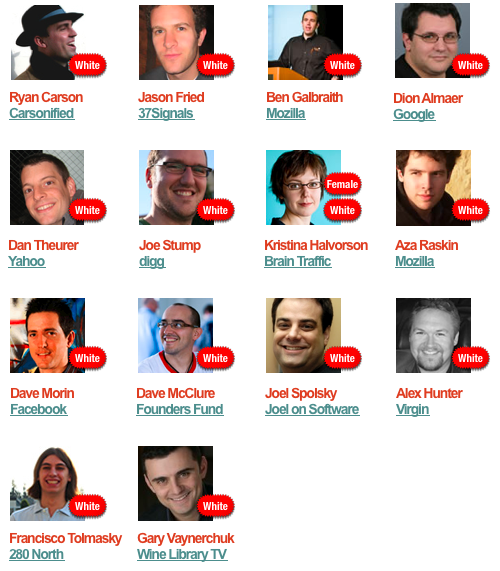
As a white boy who attended yesterday and today’s Future of Web Apps summit, I feel compelled to speak up about a disturbing element of an otherwise well-produced event.

In fact, when I got this fortune the other night, it made me realize how important it was to speak out:

You have remarkable power which you are not using.

Clearly the issue that I’m presenting is a familiar one — one of the perennials that comes around with the regularity of seasons. In the relatively short time that I’ve lived out in San Francisco and become immersed in the Valley culture, I can recall this topic presenting itself at least once a quarter. At least.

And the reason is simple: the issue of diversity in culture is intractable and unsolvable. It needs constant work and attention; it’s a matter of mindfulness and inclusivity, because regardless of how diverse you become (or think you are), you can always do better. No, really.

We can and must choose to make diversity a top priority, one that’s up there with attracting quality talent and quality attendees; it will not simply happen on its own and truly, it’s everyone’s responsibility.

But it’s not that simple, as much as I wish it were.

I talked to Ryan Carson and Lisa about this — about why there was so little diversity (especially gender diversity) at FoWA. Apparently they did try to recruit some women speakers, but the two that came to mind didn’t respond in time; so the Carson crew got tied up organizing everything else and the matter fell by the wayside. Once they had their final speaker line up, it was too late.

Perhaps if the issue had been raised far enough in advance, something could have been done (take for example the upcoming 45:2 AJAX Experience conference — all but 3 are white — apparently their trademark “No Fluff, Just Stuff” refers to minorities). This is what Elisa Camahort of BlogHer, says:

The solution is for event organizers to care about diversity in their own planning stage, not after they’ve already spent the time securing and then announcing dozens and dozens of speakers.

Totally.

And so then I talked to Matt yesterday and he pointed out that, well, maybe, the speakers represent the make-up of the community.

Which of course is a logical argument to make. And a complete cop out (sorry Matt).

There’s something important here that needs to be impressed upon us white boys by a white boy — one who happens to find himself uncomfortably in the white boy club (just coz you’re born into it doesn’t mean that you’re not responsible for being part of the change that needs to happen). It goes back to that fortune I got and to the point I made at 20×2 at SXSW last year: as it stands, we, as white men (of course I include myself in that), have a tremendous amount of privilege and power — power that many of us don’t know we have, power that many of us choose to ignore, power that some of us disclaim or shrug off. The utter reality is that whether you want it or not, you have the power and the potential to be part of the ongoing solution.

Now let me suggest an elevation of the topic, because there’s really something practical and motivating about this power that we have. First of all, it’s not something shameful and it’s not something that we ought feel bad about; admitting and owning our historically exclusionary behavior will not emasculate us. On the contrary, to my thinking, taking responsibility and doing something shows a degree of chivalry that can reveal where true insecurity lies.

But it’s not about chivalry. Because the act of diversifying should be done because of merit, not in spite of it. In fact, there are three concrete benefits to be gained from proactive inclusivity:

  • For one thing, FoWA would have been more representative, more interesting and more engaging (and better attended) had their been wider diversity. If Drupal is any indication, monocultures produce monotonous culture (think Art with a big A). And the very last thing that I, personally, want to see in the real future of web apps is a lack of diversity.The greater the diversity in the folks who are participating, creating and discussing the future of web apps will bring result in more diverse ideas, approaches, beliefs and experiences to be built into the tools of tomorrow, leading to an environment a whole lot more exciting than the alternative.
  • Instead of having to duck for cover whenever you’re exposed as a hapless ignorant fool, there’s a whole lot less guilt and worry in doing the right thing (imagine that!). You can actually feel proud of yourself for making diversity a priority (which will improve your event anyway — and likely increase the demographics of those interested in attending).So wow, doing the right thing feels good and is economically beneficial?! No way!
  • Lastly, by giving away and spreading out our power, it actually improves our position in culture while increases the visibility of our peers. I’ve long believed that in a networked world, by giving everything away, you gain more. It’s kind of the principle upon which P2P networks work.So this power that we white men have? It’s only power if we actually give it away and spread out our privilege as much as possible. In whatever form it might take, this potential power means nothing unless we actually use it — so by working to fix the problem, we’re actually proving what kind of man we are.

So let me be bold: the future of the white boy club is in inclusivity one-upmanship. Not just because it benefits everybody, but because it benefits us. We simply can’t stay hidden in our isolated little geek enclaves and plead ignorance or expect things to get better by themselves; there’s too much at stake, too much to gain and too many interesting voices out in that great bazaar that we’re missing out on that we must do more to encourage, support and welcome them where in the past we have failed.

It won’t be easy, but dammit, nothing worthwhile ever is.

And, as a first step, I’ve set up the page to collect ideas, thoughts, examples and techniques to improve BarCamp — because, frankly, we must be most critical of those things closest to us that we have proven power to change.