
Geek Entertainment TV has been sold to PodTech, where vloggers Eddie Codel and Irina Slutsky will now be reporting to former Microsoft blogger Robert Scoble.
Geek Entertainment TV has been sold to PodTech, where vloggers Eddie Codel and Irina Slutsky will now be reporting to former Microsoft blogger Robert Scoble.

When I first realized the web as a medium — like artists found clay — I was someone who built websites. I grew up an artist, dabbling with pastels, sculpture, painting; I took lessons in all the classics. Back when I started out on the web, well, I threw my paint against the wall, watched it dry differently; tried watercolor and salt; mixed in color pencil. I created on someone else’s canvas, beholden to the whims of the Internet Explorers and Netscapes.
It wasn’t until I grew frustrated trying to create a publishing and composition tool for regular folks in CivicSpace that I realized that it wasn’t that the brushes or paint that I was using that were flawed — but that the canvas itself could be streched so much further. And so when the opportunity arose to go work on and set the direction of Flock, I jumped at the chance. The thought that I could take a number of the ideas on content creation that I’d been trying to implement in regular webpages into the browser itself was too irresistible to pass up.
And that’s how it started for me — working first on the side of web content developers — and then on the side of the actual rendering context and application. I doubt that I was qualified to work on either, but that’s besides the point, since that’s where I found myself (and artists worth their weight are hardly what I would call experts).
So now, a few months out after leaving Flock, a few heady announcements about microformats, a new Firefox Beta to toy with, a number of webkit-based apps to ponder over and an emerging identity standard coming to the fore, I’m starting to see the future materialize in front of me. From where I sit though, there is a lack of clarity as to what it’s all about, what’s really going on and what’s missing in between to glue it all together and — perhaps most importantly — a sense for what we can learn by focusing on the negative space of our current situation.
I’ve been reading about Doug Engelbart lately and the stuff he was doing in the 60s with his Augment system. He’s now collaborating with my buddy Brad Neuberg on a system he calls “Hyperscope”. I can’t help but see disjoint parallels between his ideas and what’s emerging today. Simply put, there is no grand theory or unifying concept that will bring it all together, just as there’s no single design for a tree — in fact, it takes many to make a forest, and we’re only now beginning to see the emergence of the forest in spite of the individual trees that seem oh-so-important.
And we don’t even have the benefit of LSD. Man, how are we to escape what we already know to imagine what’s possible? Oh well.
Anyway, lemme get down to brass tacks, coz I can tell you’re getting bored already. I almost am, striking out at some kind of point out of this rambling.
When I was at Web 2.0™ (I think) I mentioned to Jason Fried — as I’ve done to others since — my desire to have a webwide conversation about what the future of web browsers should look like. This was the work that I thought I’d started at Flock, but the reality is that they’re a business and not an academic institution and need to pay their employees (a harsh reality that I’m now realizing owning my own company and having a payroll). I left because of this — and maybe for other personal reasons — but primarily because my vision for the future wasn’t exactly compatible with where they needed to go in the short term. Hey, bills, remember?
Anyway, let me put it out there: I don’t get where Firefox is going. I don’t think it’s going anywhere actually. I think it’s strong, it’s stable, it’s a great platform. But it’s not innovative. It’s not Quicksilver. It was a response to IE and now IE7 will come out, co-opt everything that makes Firefox great or interesting and we’ll run through another coupla years of stagnation. Blah.
There is a solution though — you’d be surprised maybe, but you can find it in Safari and I’m dead serious about this. The number of webkit-based apps being released is growing by the week. Pyro, Gcal, Webmail, Hiker (thanks Josh!). There was talk about the future of the merged Internet-desktop as, quite clearly, this is where we’re going — but the choice of user agent is sadly coming down to facility over featureset or robustness. Why isn’t this happening with XUL Runner or Firefox (you figure it out)?
At Flock, this is where I saw things going. I didn’t see Flock as a monolithic package of integrated apps like Netscape or Office — bundled up with unmaintainable software sprawl… but with a solid underlying platform that these secondary apps could be built upon (yeah, Lucene, yeah, Microformats, yeah IM, yeah video and audio and all the rest). Speaking RSS, microformats, Atom and other syndicated content natively, you’d be able to universally star anything for later sharing… you’d be able to upload anything… be able to have any AJAX’d experience offline with a super-cache that could handle the sporadic network connectivity that most of the world puts up with (or that we put up with when we travel). And hell, with OpenID, we’ve even got a way to sync it all up together. Toss in a platform that is built on and around people people people and you’ve got something to really take us forward into the next evolution of Things As We Know Them™.
I wanted Firefox to be my Chariot, Flock to be my Sun.
Such as it is with Open Source, trying to inspire end-user interface innovation is often a losing battle.
(As an aside in parentheses, I think this is biological; I met Tara’s 2-year-old niece this weekend and she mimicked everything we did; thus it’s developmental and inherent — yet the problem remains: how do we bring the majority of user interface innovation to the open source space?)
So anyway — Safari; webkit apps… the future.
For the benefit of everyone involved, whether Mozilla, Flock, Microsoft, Opera, and so on implements any of this stuff… there needs to be some major advancements made in browser technology, both for normal humans and for web… um… painters. This stuff, seriously, is still way too opaque, and way too obscure for most humans for whom “delicious” still means “tastes good”. I want to have that web-wide conversation about the future of the web but somehow, my instincts tell me that the venue to have that conversation isn’t going to be on the web… it’s going to be in barber shops and gas stations and restaurants and the places where normal people really hang out.
If we’re ever going to bear witness to the promise of Doug Engelbart’s achievable vision, it has to be this way. And, to paraphrase walkway wisdom: nothing worth doing is easy. And so I challenge you — those who give a shit — look at what’s out there — and more importantly — what’s not out there — and begin to think seriously on what comes next… on what’s missing… on where this medium needs to be stretched in order to make the most of what’s possible.
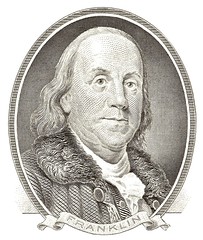 J. Matthew Buchanan discovered an interesting anecdote about Mr Franklin: that he had very little use for exclusive patents! Check out this passage from Franklin’s autobiography (grafted from Matthew’s post):
In order of time, I should have mentioned before, that having, in 1742, invented an open stove for the better warming of rooms, and at the same time saving fuel, as the fresh air admitted was warmed in entering, I made a present of the model to Mr. Robert Grace, one of my early friends, who, having an iron-furnace, found the casting of the plates for these stoves a profitable thing, as they were growing in demand. To promote that demand, I wrote and published a pamphlet, entitled “An Account of the new-invented Pennsylvania Fireplaces; wherein their Construction and Manner of Operation is particularly explained; their Advantages above every other Method of warming Rooms demonstrated; and all Objections that have been raised against the Use of them answered and obviated,” etc. This pamphlet had a good effect. Gov’r. Thomas was so pleas’d with the construction of this stove, as described in it, that he offered to give me a patent for the sole vending of them for a term of years; but I declin’d it from a principle which has ever weighed with me on such occasions, viz., That, as we enjoy great advantages from the inventions of others, we should be glad of an opportunity to serve others by any invention of ours; and this we should do freely and generously.” (emphasis added)
As Matt sumarizes: I bet if Ben were around today, he’d be an open source programmer, inventing all sorts of new software and sharing them with everyone.
After dealing with the IRS site and then hopping over to Blinksale, I realized the beauty of well-designed forms. One key ingredient? Any field in your form must be able to be figured out by your target audience. If you’re asking for something that your audience might not be able to figure out, you should explain what you’re looking for or provide an example of possible values or responses. Blinksale gets this right about 94% of the time. The government? 20. At most.
Gee, who’s site will I frequent more often and even enjoy using (ignoring that there’s hardly an alternative besides pricey lawyers for the goverment site)?
If you guessed the former, or any other site that follows this simple practice, you’d be right.
It’s not just “don’t make me think”; it’s also “please let me know what you’re thinking!“

Home of my favorites Dalliance, Mrs Eaves and Tribute, Typehaus-cum-designstore Emigre has finally shed its severe red-and-white design for something much more… typographic!
I’d argue that this proves their muster in print more than an increased grasp of the online medium (for an example, go blind trying to read their essays) but it’s good to see that these Berkeley folks who shuttered their flagship magazine last year are still alive and kickin’.
Bonus redesign: Upcoming‘s added a sweet new header!
Andrew Turner pinged me about a project I started up as an offshoot to my work with Mozes called Picoformats. He wrote that a picoformat is a standard-means for defining markup in small, probably mobile, devices
.
That’s not exactly the original idea, but it actually makes a lot of sense and, the more that Tara and I use our Blackberries, the more we see a need for standard micro-interfaces. Sure it’s great that you can download my hcard into your address book from your regular web browser, but the same seems not to hold true on mobile devices.
Anyway, that’s an issue that needs to be addressed in mobile browsers, and Opera‘s well on their way working on such problems.
Andrew’s post did highlight both the need for me to get the word out about this project and also explain it a little more clearly since Microformats could actually address the formating of data for mobile devices (especially when we start pairing up microformatted content with relevant media-specific CSS).
The goal of the Picoformats project is to use an open process that reflects existing behavior and come up with standards for an SMS-based dialect for interacting with mobile services.
Dodgeball already has a pretty good SMS/email dialect. In fact, I use it all the time. What I want is service interoperability, so that when I send a message to (okay, I’ll reveal my bias) Mozes, I can use the same syntax to compose the command or message. For example, if I send a message formed like this: “! heading to the movies at 10pm”, it shouldn’t matter if I’m on Dodgeball, Facebook Mobile, MySpace Mobile, or FactoryCity Mobile — each service that supports Picoformats should send out the blast message to my friends, just as I’d expect it to. But already there’s divergence — with Mozes using “@” for blast messages and Dodgeball using “!”. This is the kind of thing that will make it extremely hard for people to move between services or, worse yet, use a multitude of services.
You can probably begin to see how this is similar to life before Adium or Trillian. Personally, I like not having to run 5 different instant messenger apps. I like having them all in one and being able to IM my friends regardless of the service they’re on from one interface. I’d like to be able to do the same with the mobile services I use. And that’s why this Picoformats idea is important — it’s syntactic interoperability.
Microrant: Basecamp needs OpenID. It’s already on someone else’s wishlist, but I’m going to put it out there for posterity’s sake. I work in no less than 8 different Basecamps — all with whack-ass URLS (x.projectpath.com, y.updatelog.com, etc) and different usernames, depending on who set it up and whether I had the time to go and tweak my username.
PBWiki implemented centralized identity — why can’t Basecamp? Better yet, why doesn’t it use OpenID and let me use one the personas I’ve already set up somewhere else? Seriously — this is a major hurdle for spreading inter-organization Basecamp use.
So from using open-source AJAX library DojoToolkit to creating and implementing the widget microformat, they seem to be doing some things right — of course my profile looks like arse, but the possibility for greatness persists.
 Apparently someone named Ben Horst has taken up the failed SpreadOpenOffice initiative in order to buy out the back page in New York free daily Metro, following in the footsteps of Spread Firefox’s campaign which lead to a two-page ad in the New York Times last year (which I designed).
Ben’s goal of raising $5,000 is a bit more modest than the $100,000 we set out to collect in 10 days (raising nearly $250,000 by the end) — and the audience of the Metro is noteably smaller and less geographically diverse than the TImes, but the effort is nonetheless to be commended.
I have my own issues with OpenOffice as a product, but I do wholeheartedly support Ben’s efforts to galvanize the community around a specific action. He’s currently 75% of the way through raising funds and there’s already been a good deal of pick-up on Digg and Slashdot so I imagine he’ll meet his goal before his self-imposed deadline.
It’s interesting to see this effort emerge organically — especially after the initial thrust to create a SpreadOpenOffice project fashioned after Spread Firefox died on the vine owing to internal struggles over branding control. A similar project SpreadKDE made it out of the gate, but it’s unclear whether it ever took off.
So why did it work for Mozilla? And will it work for others? Not sure, but it’ll interesting to see whether Ben’s micro-donation effort pays off.
Network discrimination is basically the equivalent of creating a first class seating section on the internet. And I hate the whole first class/stearage thing. JetBlue succeeds in part because it did away with this hierarchical system. Why should the net go backwards?
 Factory Joe